
What does a good strategy toward climate-neutral aviation in 2070 look like?
This question marked the starting point of our most recent interdisciplinary team activity at Bauhaus Luftfahrt, aimed at delivering a Scenario Framework. More specifically: What will be the scale of investment and economic implications of different transition pathways? Answering these questions requires looking beyond individual technologies across a wide range of possible technological developments and economic conditions.
Exploring different future scenarios calls for modeling the complex interplay between these elements – models that account for energy supply economics, air transport network evolution, aircraft technology development, and their environmental and societal impacts.
Our Scenario Framework was developed as a modular approach to structure this complexity into manageable, transparent elements. The framework integrates complementary perspectives that together provide a coherent techno-economic view of various pathways of aviation’s long-term transition.
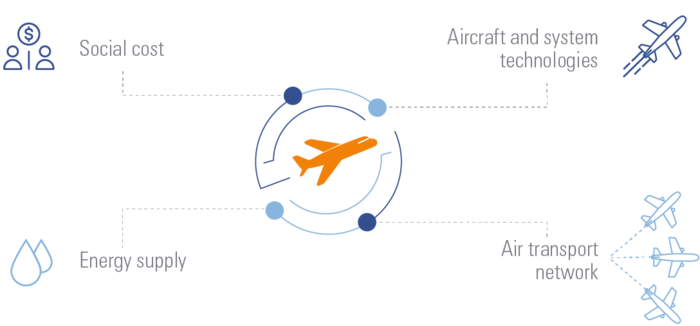
A modular framework for aviation’s transition
Each module establishes key assumptions and addresses a specific system dimension, allowing insights to be traced from broad socio-economic developments to concrete technological choices and their societal consequences. The five modules are:


Aircraft technology development – Aircraft, including their associated costs, benefits, and performance trade-offs.

The evolution of the energy mix – Fuel, and the scale of investment required, scale-up requirements, and production cost trajectories for different fuel pathways.

Fleet dynamics & market adoption – Market & Fleet, reflecting how technologies are adopted and operated within a competitive environment.

Climate impacts and social costs – Climate, linking aviation’s transformation to environmental impacts and societal welfare.
For some solutions, the complexity of the system requires iterative interactions between modules rather than a simple sequential execution. For example, the optimization of fleet costs defines requirements for fuel availability, while fuel costs themselves depend on overall demand. This circular dependence illustrates the tightly coupled nature of some of the fundamental decisions shaping the future of aviation which cannot be solved in a straightforward, analytical way.
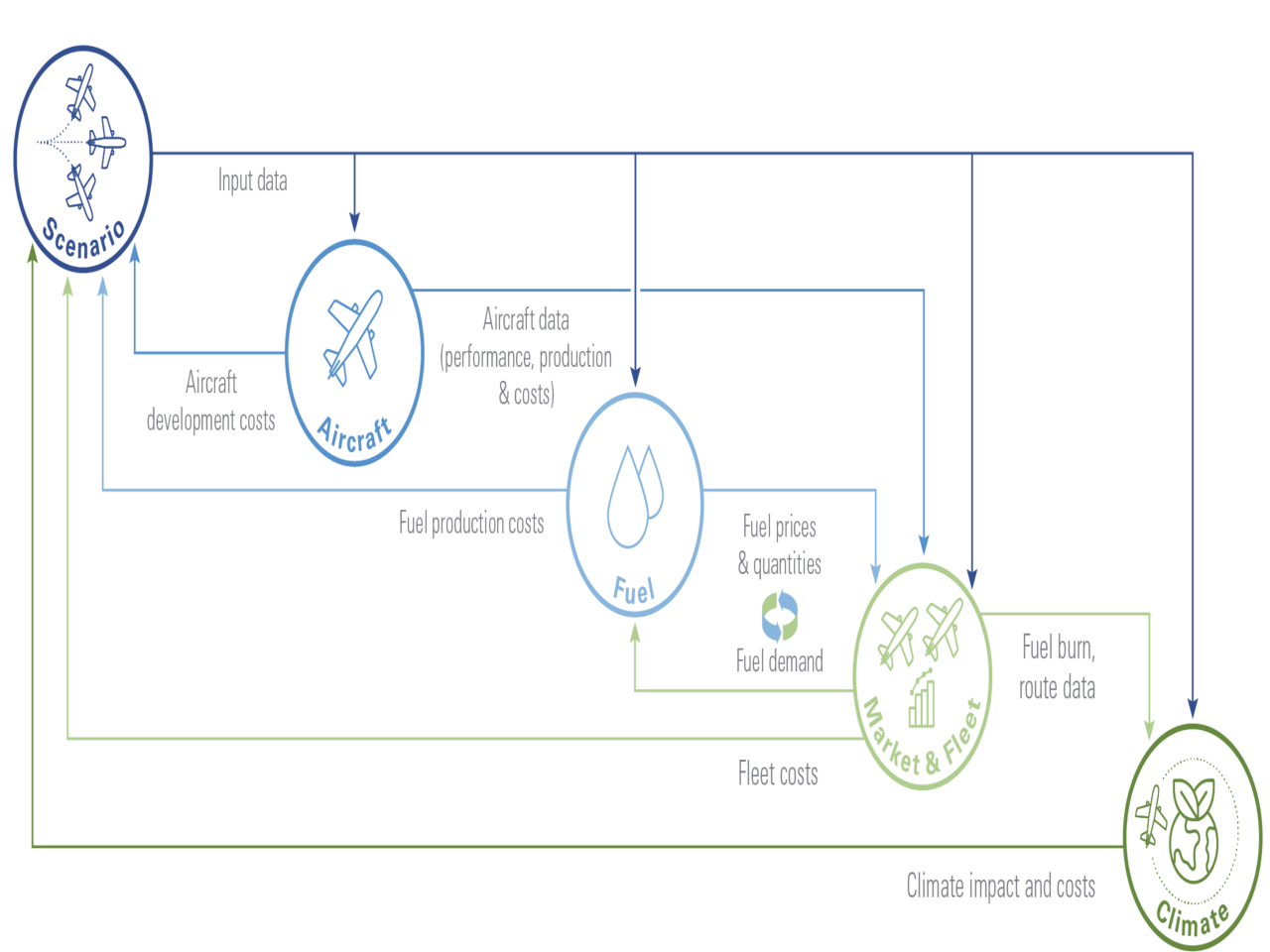
The Scenario Framework’s modular approach divides the analysis into five modules, each examining a critical aspect of aviation’s transformation: Aviation Demand & Economic Growth, Aircraft Technology Development, Energy Mix Evolution, Fleet Dynamics & Market Adoption, and Climate Impacts & Social Costs. The results are interpreted through a set of four narrative aviation strategies. To assess the implications, each strategy is evaluated against a conservative baseline, allowing consistent comparison of costs and benefits.
- Baseline – Characterized by moderate to low decarbonization efforts and continued reliance on fossil fuels.
- SAF-led – A pathway requiring large-scale investment to enable global deployment of sustainable aviation fuels (SAF) at up to 100 % substitution of fossil kerosene.
- H2-led – A scenario where liquid-hydrogen aircraft become commercially available by 2050, supported by parallel development of the required hydrogen infrastructure and SAF synergies.
- Aircraft-led – An efficiency-driven pathway, introducing new aircraft generations achieving approximately 30% efficiency improvement by 2035, then an additional 15% in 2050 and again in 2060.
Assessing transition pathways
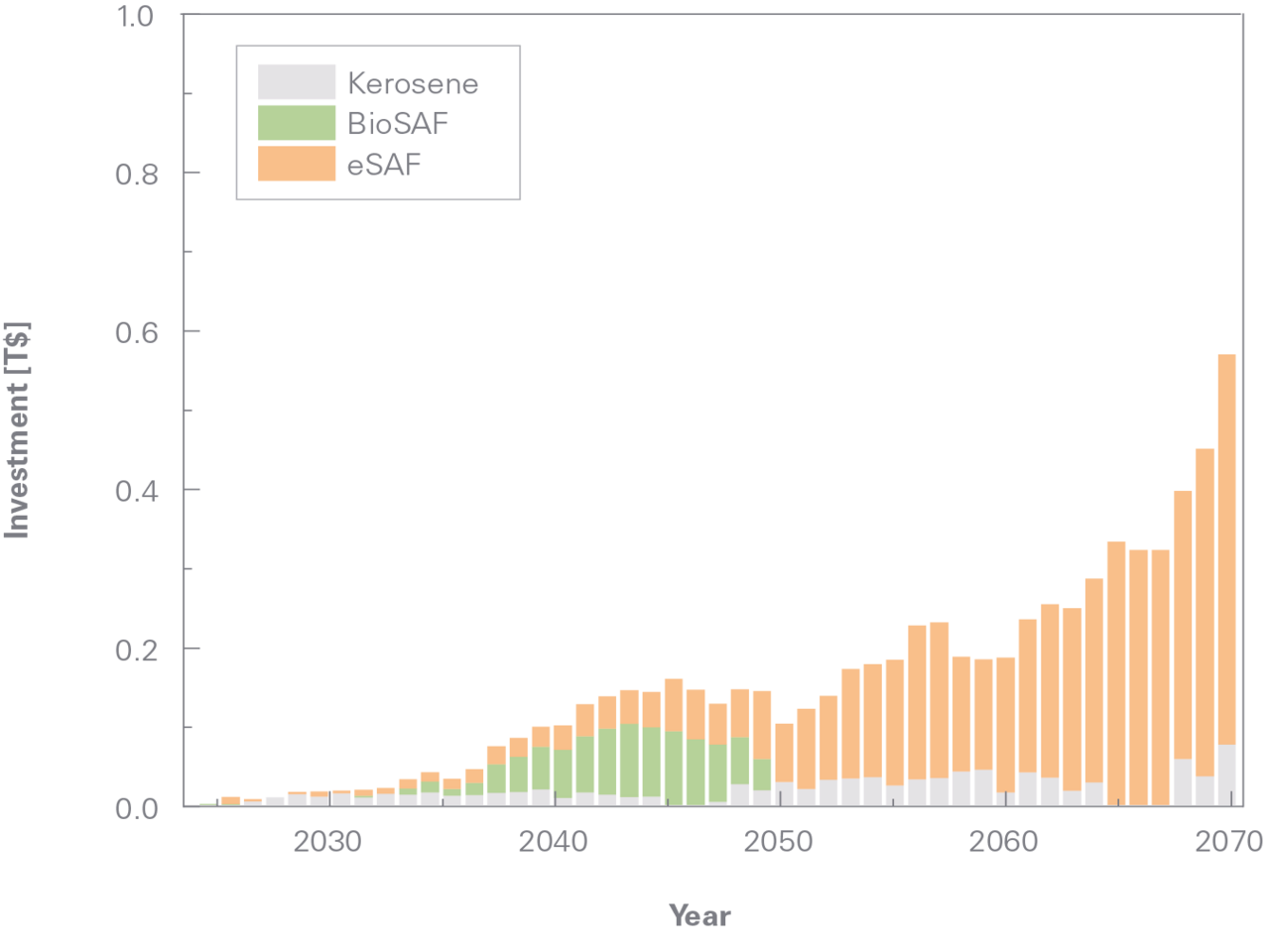
Investment: The continuous deployment of renewable energy and fuel requires substantial global investment. This includes the construction of production plants worldwide, as well as the development, scaling, and ongoing improvement of fuel synthesis and distribution technologies.
Bio-based SAF may be competitive in early transition stages but is expected to face increasing feedstock competition from other sectors over time. Even under the conservative baseline scenario, achieving a 70% blending ratio by 2050 would require significant worldwide investment in the order of several hundred billion euros annually. The SAF-led scenario shows a 30% increase in the required investment to achieve a close to 100% blending ratio by 2060.
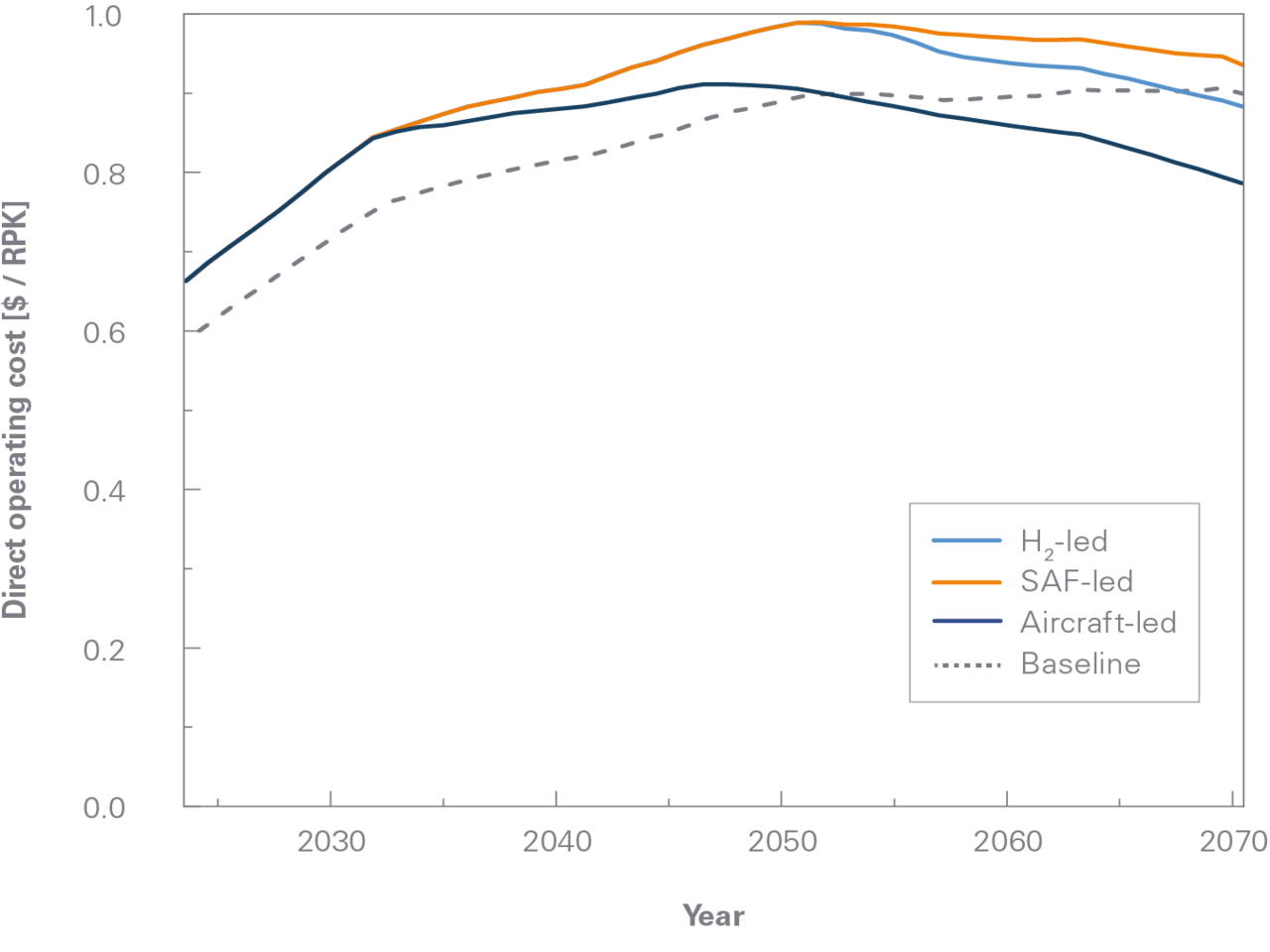
Operational cost: This is driven primarily by fuel prices, carbon pricing, aircraft depreciation, and fleet renewal. Under the assumptions of this study, the operational cost normalized by revenue passenger-kilometer (RPK) increases across all scenarios, largely due to the higher costs associated with alternative fuels.
In the following decades, the baseline scenario remains approximately ten cents per RPK cheaper than other pathways. However, this gap gradually narrows and eventually reverses after 2050, with the baseline scenario surpassing the costs projected for the more ambitious transition pathways. This indicates that more moderate investment levels do not necessarily result in lower long-term costs for the sector. In other words, delaying the transition today may lead to higher operational costs in the future.
Environmental impact: Aviation’s climate impact, measured using efficacy-weighted global warming potential (f-GWP), may reach annual emissions of around 2.8 Gt CO2-equivalent by 2070 under moderate investment assumptions. In comparison, the SAF-led scenario could reduce this impact to around 2.1 Gt, while the aircraft-led pathway shows further climate benefits, reaching approximately 1.7 Gt.
The H2-led scenario presents additional challenges due to large uncertainties associated with contrail formation. While these effects will require revisiting as more experimental data become available, the combined reduction of volatile and non-volatile particle emissions enabled by hydrogen-combustion engines, together with operational rerouting strategies, could significantly lower the climate impact, potentially reaching around 0.75 Gt by 2070.
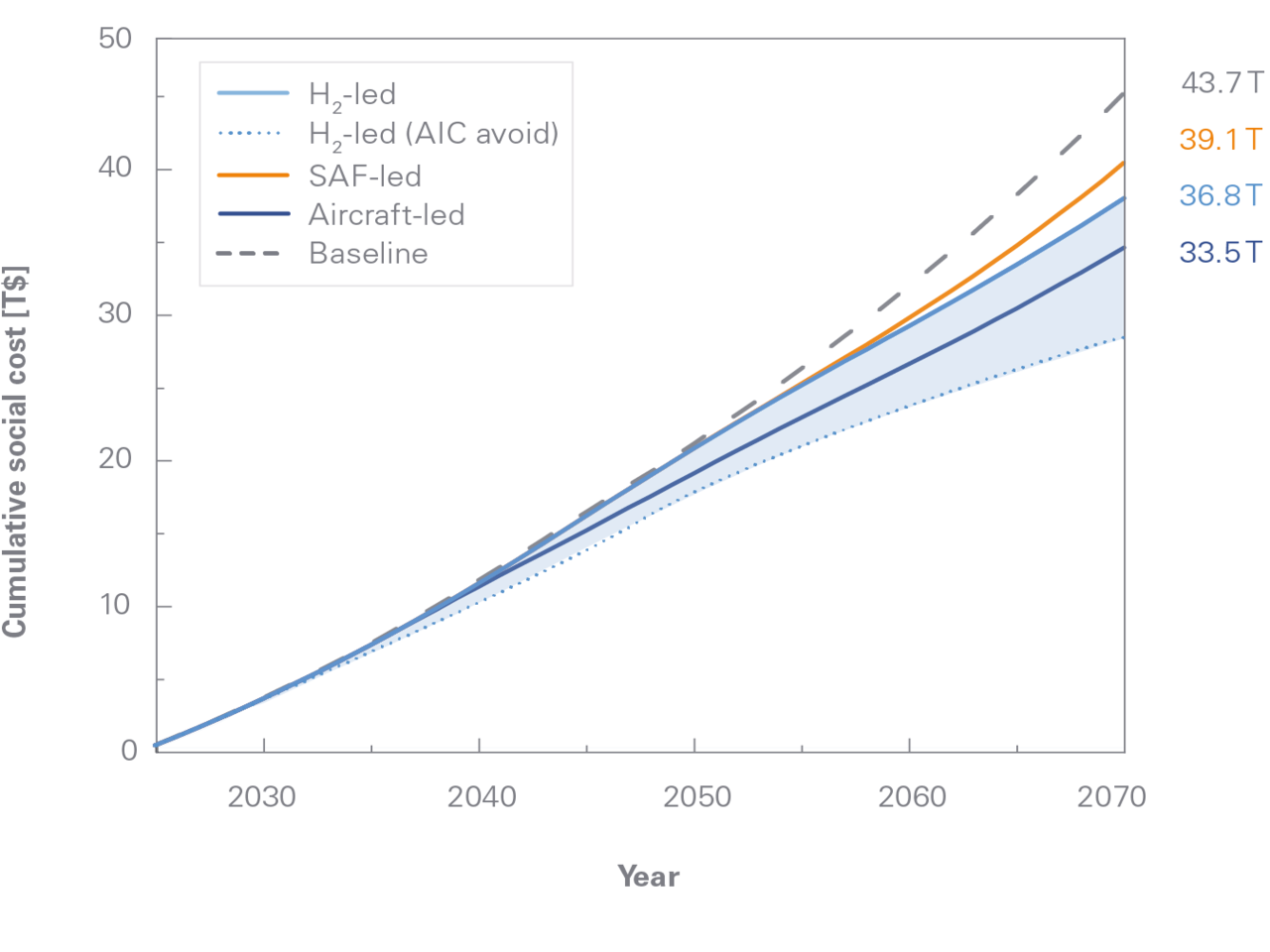
Social cost measures the monetized value of the impacts caused by an incremental increase in CO2 emissions, including effects on human health, agriculture, energy systems, and weather-pattern disruptions – representing a long-term welfare loss extending far beyond when emissions occur. However, this metric typically focuses on climate-related impacts alone. By accounting jointly for CO2 emissions, non-CO2 climate effects, and local air-pollution impacts, we provide a more comprehensive assessment of the societal consequences of aviation’s transformation.
Social costs accumulated annually through 2070 evaluate the benefits of different pathways in avoided damages relative to the baseline. Under our assumptions, this translates into societal benefits on the order of several trillion euros, with the aircraft-led scenario delivering the highest societal benefits.
Aviation climate impact
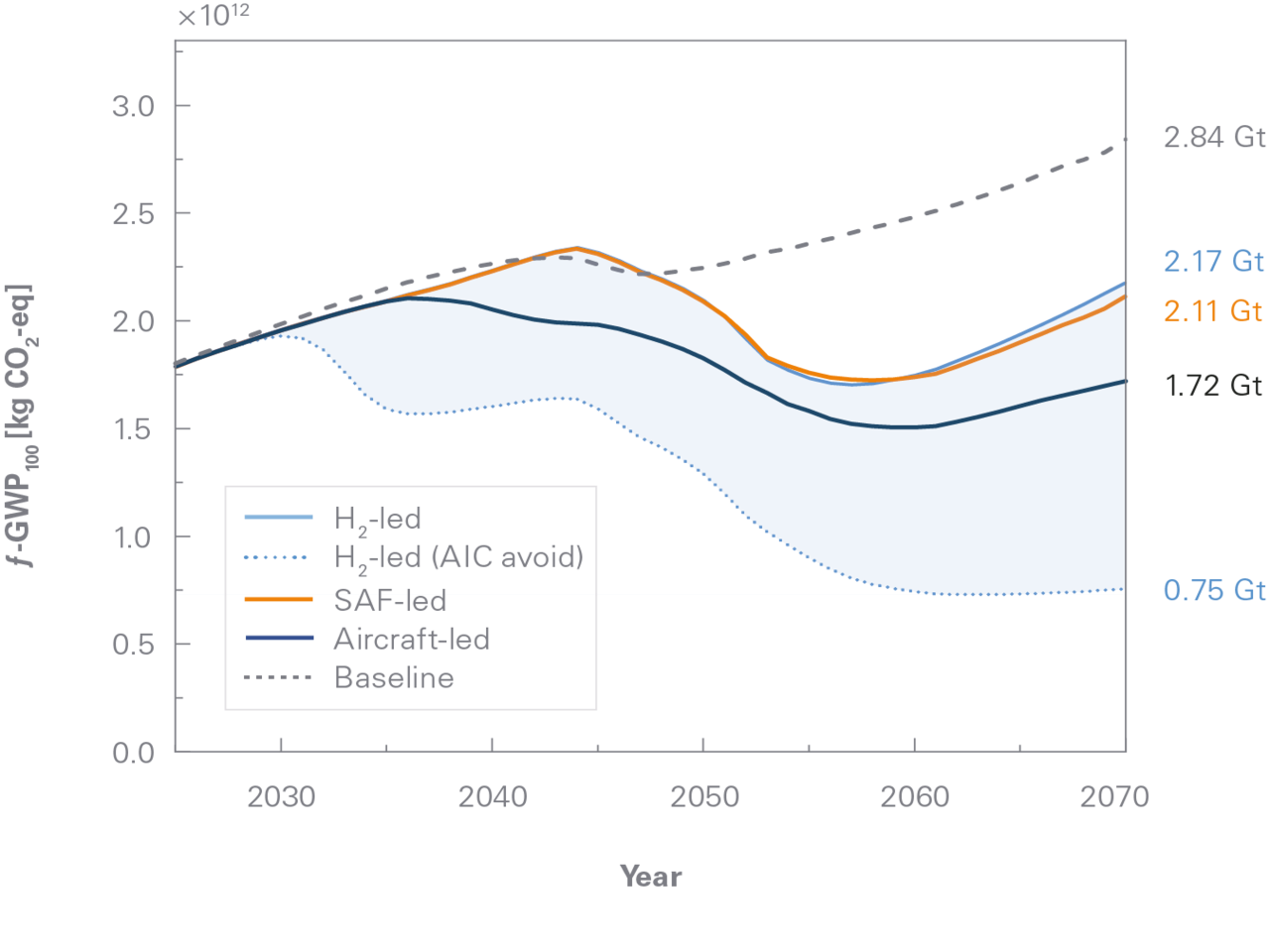
Investments in high-efficiency aircraft concepts show the greatest leverage for mitigation reaching a reduction of - 40%.
Strategic implications
Far-reaching consequences of today’s decisions
These scenarios are not intended to predict a single future. Instead, they reflect how decisions taken today can have far-reaching consequences for aviation’s evolution over the coming decades – which in turn affects global economic development and societal welfare.
Fuel transition drives operational cost increase. The combined effect of carbon pricing and the introduction of SAF and liquid hydrogen is expected to increase operational costs by approximately +35% to +55% per RPK across scenarios.
Liquid hydrogen offers long-term cost advantages despite higher aircraft costs. Although H2 aircraft entail higher upfront costs, they can lead to lower long-term operational costs, particularly when synergies with SAF availability and energy system evolution are considered.
Aircraft efficiency remains the strongest cost-reduction lever. Highly efficient next-generation aircraft show the greatest potential to mitigate fuel-related cost increases. Despite high development and acquisition costs, operational costs are reduced, making efficiency improvements a critical enabler across all transition pathways.