
Trend Monitor 2026 describes four aviation futures, shaped by the trends of hydrogen flight and geopolitical tensions. The scenarios are based on the impact and uncertainty scoring by experts and GenAI agents, executed last year (read more about the approach).
The trend of Geopolitical tensions had the highest impact score, while hydrogen flight had the highest uncertainty score. By varying the “states” of these trends, we obtain four possible scenarios from the scenario matrix.
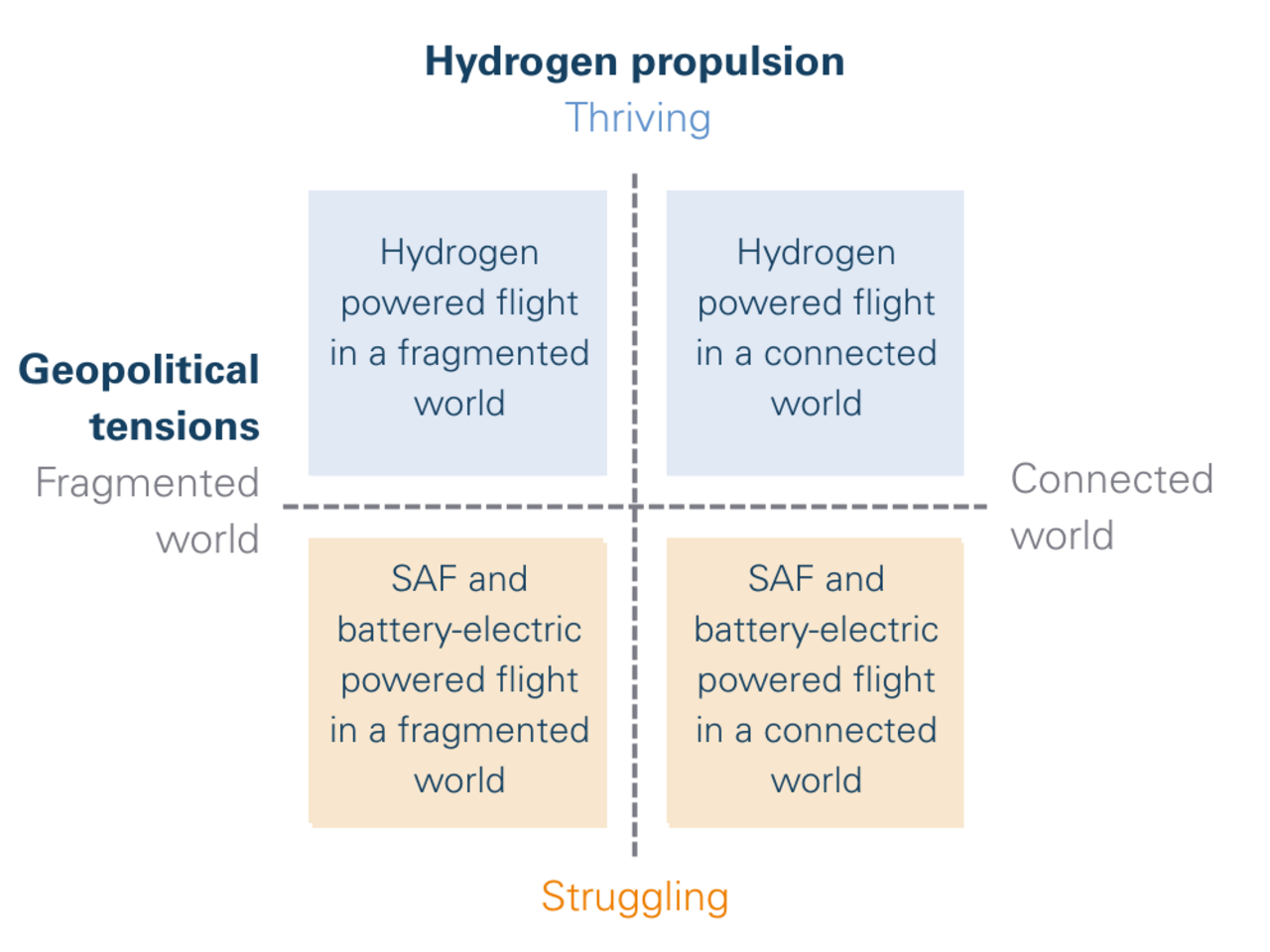
For hydrogen flight, the “thriving” state is one where hydrogen fuel cell and combustion aircraft now enable short- to mid-haul flights. The “struggling” state is one where SAF and battery-electric propulsion are the only sustainable technologies available to aviation. In a “fragmented” world, various geopolitical tensions impose severe restrictions on air travel. In a “connected” world, on the other hand, these issues and restrictions are absent, and air-travel thrives.


To develop these scenarios, we have used the framework of Lightweight Retrieval-Augmented Generation (LightRAG)
Retrieval-Augmented Generation (RAG) is an AI technique where a large language model first retrieves relevant information from an external knowledge source (such as documents that we provide to it) and then uses that retrieved context, together with its pretrained knowledge, to generate an answer. This makes outputs more accurate, up to date, and domain-specific without retraining the underlying model.
LightRAG is a specific framework that augments text indexing and retrieval in RAG with a knowledge graph. Through a dual-level retrieval mechanism, the system retrieves both fine-grained facts (low-level entities and relations detailed in the knowledge graph) and higher-level topics (from the indexed text). In practice, LightRAG combines retrieval based on semantic similarity of text-chunks with graph-based relationships, to return context that is both relevant and structurally coherent for the language model to answer complex queries efficiently.
In our LightRAG system, custom-built for describing scenarios, we start by providing the system scientific publications and reports (see list below) that describe the ecosystems of SAF, battery-electric and hydrogen powered aviation, and associated challenges, and potential impacts. Additionally, we also provided documents that describe how geopolitical strife has and/or may affect aviation.
These documents are split up into chunks of text and stored in a vector database, a specialized database that stores and indexes data as high‑dimensional numerical vectors (embeddings) so that an LLM can quickly find items that are similar to a given query in meaning, rather than only matching exact keywords or values. In parallel, an LLM agent reads through the conclusions of these publications, to form knowledge graphs that are composed of different entities and the relationships between these entities. The agent was instructed to obtain entities that have to do with technology, infrastructure, policy, barriers, organizations and metrics. Possible relationships included “enables”, “requires”, “develops”, “depends on”, “causes”, “affects”, and “competes with”.


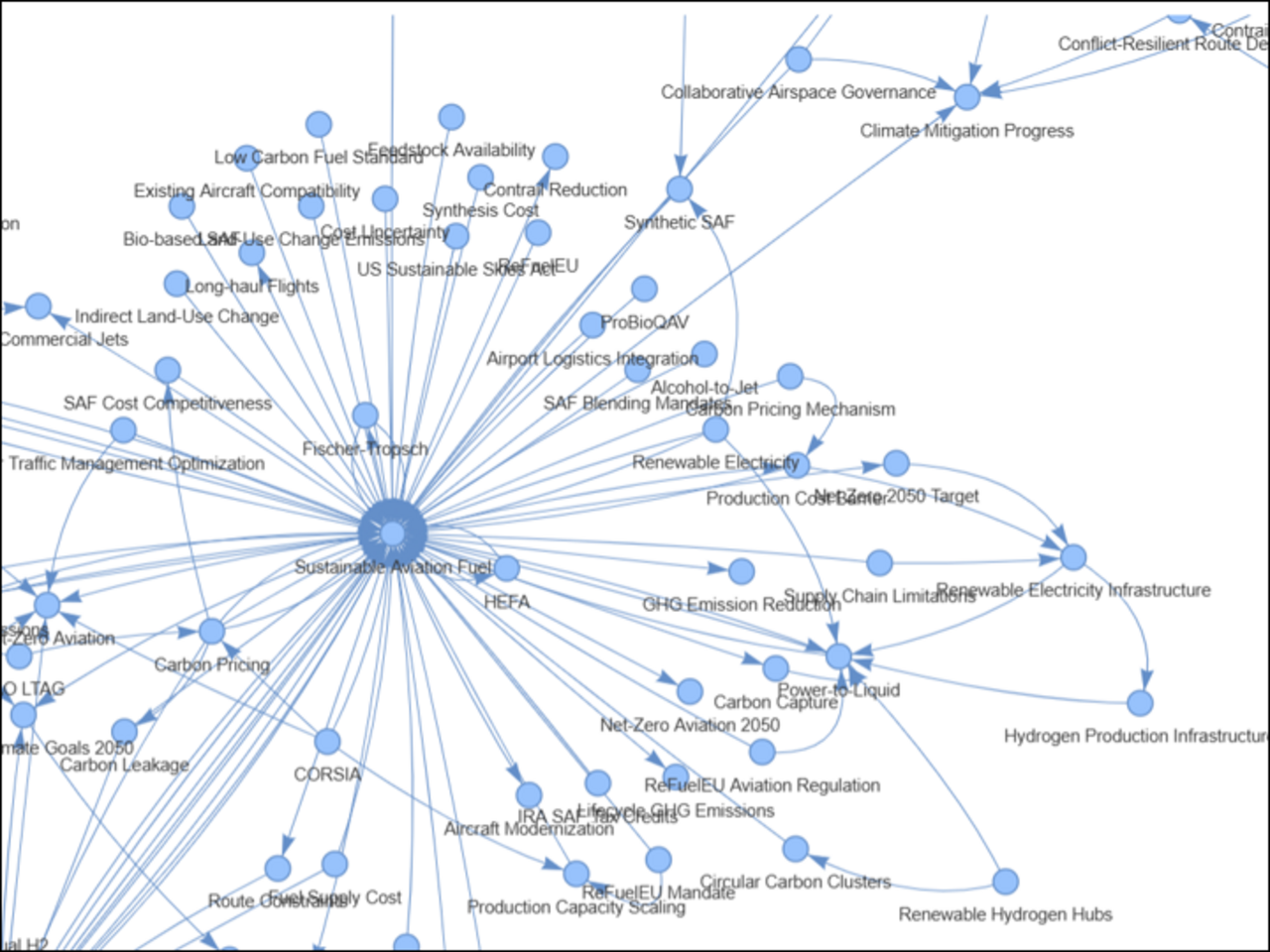

Once the vector database and knowledge-graph are created, we can start getting the LLM to describe the scenarios. We begin this process by providing a short description for each scenario. For instance, for our fourth scenario, we provided this description – “Battery-electric and sustainable aviation fuels dominate in a fragmented world with geopolitical issues that restrict air travel. Hydrogen propulsion for aircraft does not exist.”
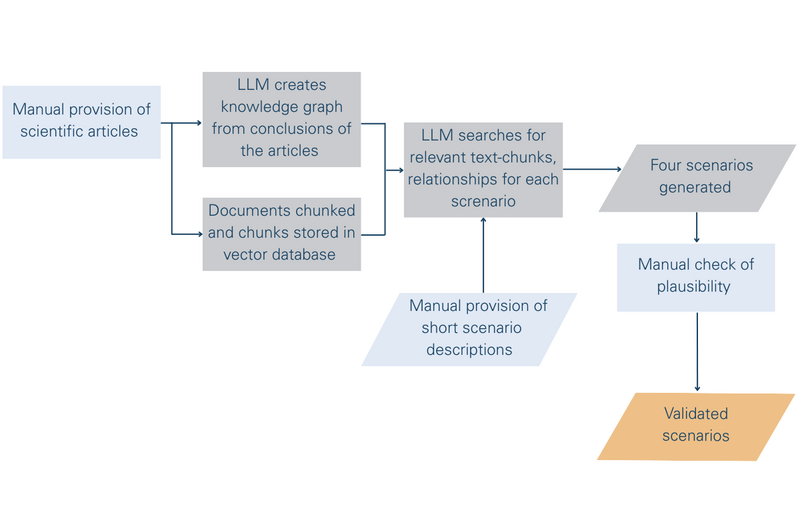
Once the scenarios are generated, we had multiple rounds of internal experts at Bauhaus Luftfahrt examining the scenarios for implausibilities and hallucinations. As the experts opined that some of the developments, especially connected to hydrogen propulsion, seemed too optimistic for 2035, we have redesigned the scenarios to not be anchored in a particular year. Rather, these scenarios simply describe (near) futures where different technologies and geopolitical events combine.
Below, we have all four of the scenario descriptions obtained through this process. But first, we list here the scientific publications and reports provided to the LightRAG system:
- Airports Council International, & Aerospace Technology Institute. (2021). Integration of hydrogen aircraft into the air transport system. Airports Council International. https://www.ati.org.uk/wp-content/uploads/2021/08/aci-ati-hydrogen-report-1.pdf
- Barnard, M. (2025, February 10). Airbus drops hydrogen as aviation industry admits it won’t fly. CleanTechnica. https://cleantechnica.com/2025/02/10/airbus-drops-hydrogen-as-aviation-industry-admits-it-wont-fly/
- Braun, M., Grimme, W., & Oesingmann, K. (2024). Pathway to net zero: Reviewing sustainable aviation fuels, environmental impacts and pricing. Journal of Air Transport Management, 117, 102580.
- Chang, Y. C., Chen, Y. T., & Tseng, W. C. (2022). How aviation market is influenced by political policy-the case of Taiwan and China. Transportation Research Procedia, 65, 133-143.
- de Vries, R., Wolleswinkel, R. E., Hoogreef, M., & Vos, R. (2024). A new perspective on battery-electric aviation, part II: Conceptual design of a 90-seater. In AIAA Scitech 2024 Forum (p. 1490).
- Dsouza, L. F. (2025). Hydrogen Aircraft and Sustainable Development: Efficiency, Innovation, and Environmental Impact. Innovation, and Environmental Impact (April 13, 2025).
- Henley, L. D. (2023). China Maritime Report No. 26: Beyond the First Battle: Overcoming a Protracted Blockade of Taiwan.
- Liao, M., Cheung, T. K., Wong, C. W., & Zhang, A. (2025). Resilience in the Face of Disruptions: Assessing the Impacts of COVID-19 and Geopolitical Conflicts on Global Airport Connectivity. Journal of the Air Transport Research Society, 100069.
- Lindberg, M., & Leijon, J. (2025). Electrifying aviation: Innovations and challenges in airport electrification for sustainable flight. Advances in Applied Energy, 100222.
- Oesingmann, K., Grimme, W., & Scheelhaase, J. (2024). Hydrogen in aviation: A simulation of demand, price dynamics, and CO2 emission reduction potentials. International Journal of Hydrogen Energy, 64, 633-642.
- Pattanayak, T., & Mavris, D. (2025). Battery technology for sustainable aviation: a review of current trends and future prospects. Applied Energy, 397, 126356.
- Raab, M., Dietrich, R. U., Philippi, P., Gibbs, J., & Grimme, W. (2024). Aviation fuels of the future− A techno-economic assessment of distribution, fueling and utilizing electricity-based LH2, LCH4 and kerosene (SAF). Energy Conversion and Management: X, 23, 100611.
- Schwab, A., Thomas, A., Bennett, J., Robertson, E., & Cary, S. (2021). Electrification of aircraft: Challenges, barriers, and potential impacts (No. NREL/TP-6A20-80220). National Renewable Energy Lab.(NREL), Golden, CO (United States).
- Wandelt, S., Zhang, Y., & Sun, X. (2025). Sustainable aviation fuels: A meta-review of surveys and key challenges. Journal of the Air Transport Research Society, 100056.
- Wang, B., Ting, Z. J., & Zhao, M. (2024). Sustainable aviation fuels: Key opportunities and challenges in lowering carbon emissions for aviation industry. Carbon Capture Science & Technology, 13, 100263.
- Wang, X., Zhang, J., & Wandelt, S. (2023). On the ramifications of airspace bans in aero-political conflicts: Towards a country importance ranking. Transport Policy, 137, 1-13.
- Xue, D., Chen, X. M., & Yu, S. (2025). Sustainable aviation for a greener future. Communications Earth & Environment, 6(1), 233.
- Xue, D., Du, S., Xu, Y., Zhang, Q., & Sun, X. (2025). Airspace closure challenges: Exploring the impact of the Russia-Ukraine conflict on flight operations and pathways to solutions. Transportation Research Interdisciplinary Perspectives, 31, 101396.