


The ATLAS project focuses on developing a simulation and evaluation environment for the air transport system, providing guidelines for low-climate-impact long-range aviation (entry into service, 2040–2045), and establishing a national process for scouting and initial assessment of early-stage technologies from the global technology landscape with potentially disruptive, long-term potential towards climate-neutral aviation.
Long-haul aviation represents only about 10% of the global fleet, yet accounts for around 35% of global kerosene consumption and 40% of total transport capacity (available seat kilometers) in commercial aviation. Given its significant environmental footprint, the long-haul segment holds enormous potential for impact in achieving climate-neutral air transport. However, this transformation is complex. Every technological, operational, or infrastructural change has far-reaching consequences within the broader air transport system. The project aims to understand these interdependencies and identify synergies that can accelerate the transition to sustainable air transport.
Objective of the project is to provide the simulation and evaluation capabilities at all three system levels – air transportation system, aircraft and individual technology – by:
- developing a publicly accessible simulation and evaluation environment for the air transport system that enables a holistic assessment of the climate impacts of new technologies and operational measures,
- deriving transparent, actionable recommendations on technologies, their combination, and resulting aircraft concepts for the next generation of long-haul aircraft with an entry-into-service of 2040–2045, and
- establishing a national scouting and initial-assessment process to identify new/radical early-stage technologies with high leverage for climate-neutral aviation, providing recommended practices to accelerate their adoption.
By the end of the project, software tools and methods will be provided to enable an evidence-based discussion of the benefits and trade-offs of individual technologies and concepts on the path to climate-neutral aviation. ATLAS will deliver actionable recommendations for transitioning towards a climate-neutral air transport system by 2050.
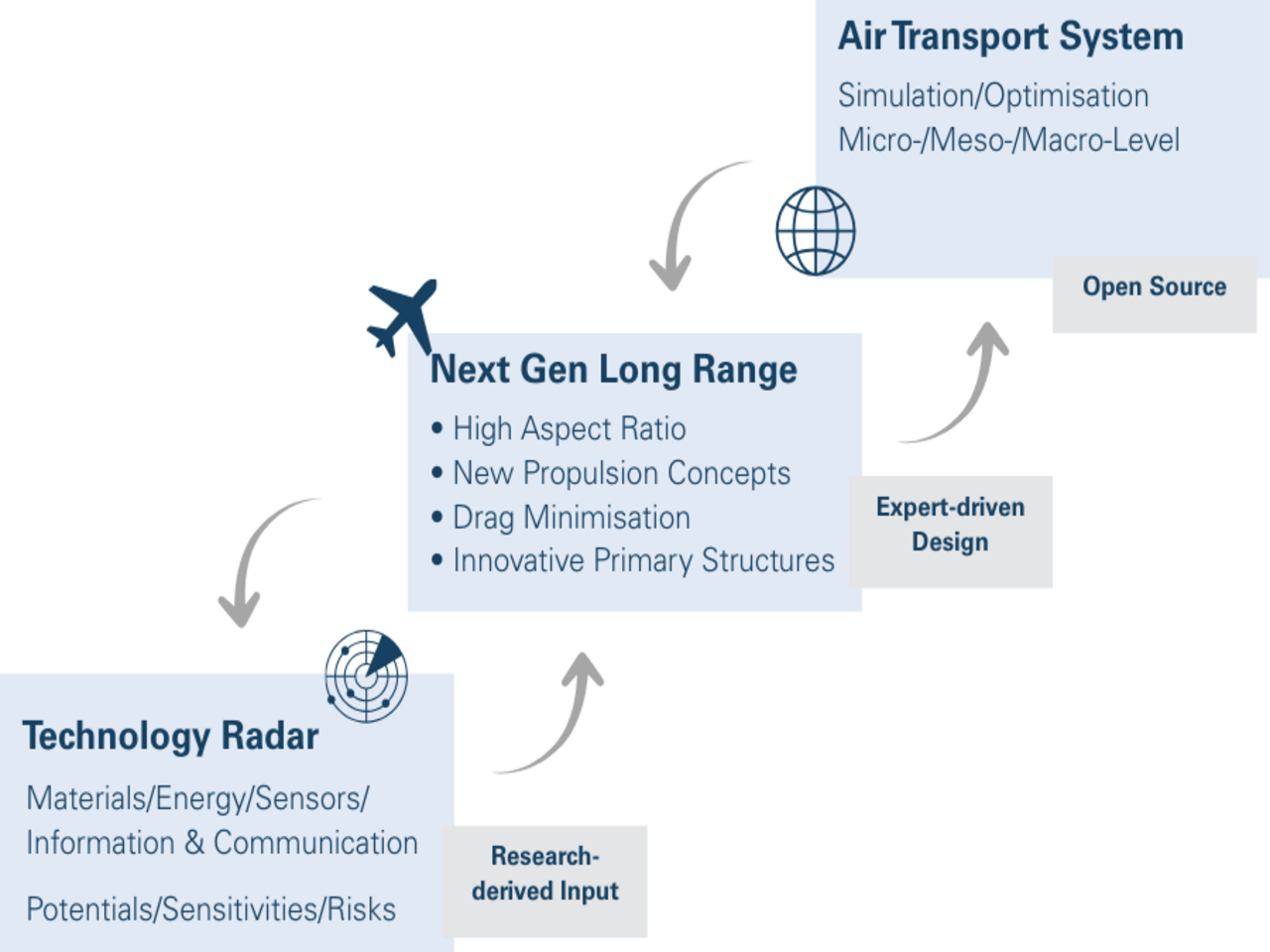
Bauhaus Luftfahrt is contributing at all main system levels – the air transport system, aircraft and propulsion as well as individual technologies – and is responsible for the following tasks
- integrating a fleet model into the overall air traffic simulation environment & validation with realistic scenarios to enable the assessment of long-term climate impacts of new technologies at fleet level,
- analyzing a disruptive, synergistic propulsion concept for next-generation hydrogen-powered long-haul aircraft, supporting aircraft-level integration and assessment and validating critical aspects with our BLADE software,
- leading the establishment and implementation of the Bauhaus Luftfahrt scouting and initial-assessment approach (Technology Radar) in the consortium as a whole, to identify high-leverage early-stage technologies (materials, energy, information and beyond) for climate-neutral aviation, and generating the technology roadmap.
Technical University of Berlin (TUB)
Technical University of Braunschweig (TUBS)
Technical University of Dresden (TUDD)
Technical University of Darmstadt (TUDA)
Technical University of Hamburg (TUHH)
Technical University of Munich (TUM)
University of the Federal Armed Forces Munich (UniBW)
University of Stuttgart (USTUTT)

The project is funded by the Federal Ministry for Economic Affairs and Energy of Germany under the funding code 20M2438J.