


Head of Innovative Propulsion Systems
arne.seitz[at]bauhaus-luftfahrt.net
+49 89-3074-84921
The HybVer project focuses on the holistic design and integrated evaluation of an innovative propulsion concept featuring partially electric compressors.
The specific injection of electrical energy into the gas turbine cycle is expected to significantly improve the overall efficiency, flexibility and compressor design. Specifically, HybVer is investigating a cycle-integrated parallel hybrid concept in which both the high-pressure shaft and individual compressor stages are electrically assisted. Since the electrical energy is supplied by batteries, the studies focus on regional turboprops and medium-sized helicopters.
The central task is to fully achieve Technology Readiness Level (TRL) 2 and to evaluate the developed propulsion concept in terms of flight performance, efficiency gains, and emission reductions. For this purpose, key questions regarding compressor aerodynamics, operational behavior, electrical system components, compressor design, mechanical design as well as overall conceptual design integration at overall propulsion system level and aircraft level, are being addressed.
Since most aircraft are operated well below their intended design range, higher degrees of hybridization and better fuel consumption can be achieved on shorter routes by fully utilizing the installed electrical storage capacity. This leads to a significant reduction in emissions and enables optimized propulsion system sizing for the entire operating spectrum of the aircraft.
The HybVer propulsion system concept and application cases
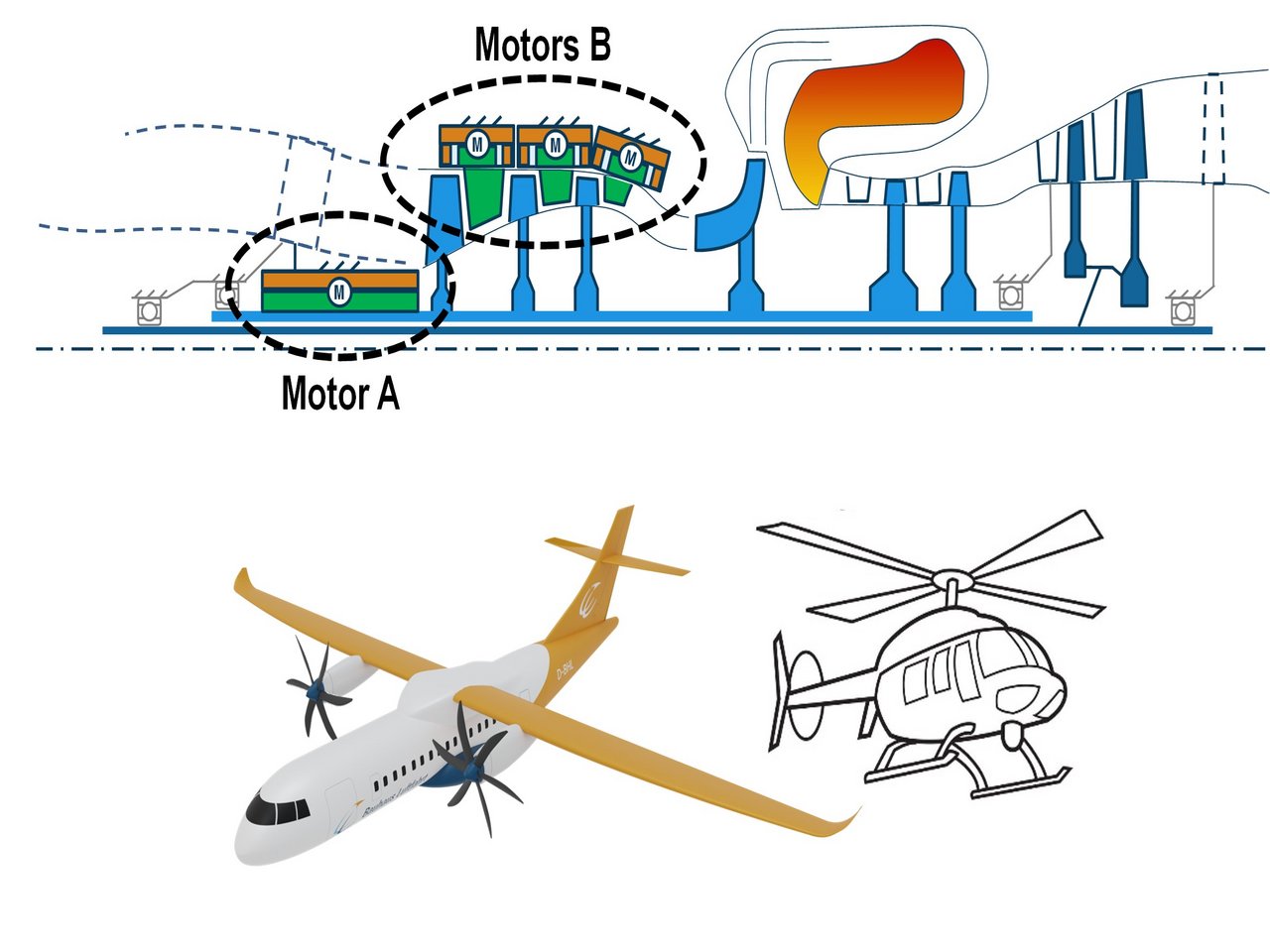
Bauhaus Luftfahrt is responsible for project coordination, overall conceptual design and integrated evaluation of the “HybVer” technology. The detailed results of the consortium partners are incorporated into the performance synthesis model at the propulsion system level. A final evaluation of the fuel savings potential at aircraft level enables an assessment of environmental friendliness and realistic application potential for integrated, parallel hybrid aircraft propulsion systems.

The project is funded by the Federal Ministry for Economic Affairs and Energy of Germany under the funding code 20E2111.