
What is the current status of the energy transition in the transportation sector in Germany, Europe, and worldwide? This is outlined in the monitoring report “Renewable Energies in Transportation” by the Deutschen Biomasseforschungszentrums (DBFZ). Bauhaus Luftfahrt has contributed an overview of the aviation sector.
In air transport, specific CO2 emissions per passenger kilometre have been markedly reduced over recent decades by means of technical and operational improvements. However, the long-term average efficiency gains of around 1 % per year were offset by far higher growth in traffic volumes. In the decade prior to the COVID-19 pandemic, global fuel consumption rose each year by around 4 % and reached some 300 million t in 2019, with the associated CO2 emissions amounting to 1 GtCO2. Current growth forecasts for the aviation industry suggest that the fuel demand in 2025 will reach pre-crisis levels and will continue to rise for the foreseeable future, as the projected growth is estimated to be far higher than the anticipated efficiency gains.
In addition to technical and operational enhancements, the demand for fuel can be directly impacted by shifting or avoiding the volume of traffic. However, the majority of aviation emissions are generated on medium- or long-haul routes, which can scarcely be shifted to other modes of transport. Moreover, especially on longer routes, the volume of traffic is mainly connected to leisure travel and maintaining social ties. Accordingly, a trend reversal is unlikely in a globalised world where an increasing share of the world’s population can afford air travel. Unless far-reaching crises occur, a robust growth in traffic is more likely. In such a scenario, substituting conventional fuel with low-emission energy carriers is the only option that remains for reducing the otherwise rising emissions within
the aviation sector.
Both non-CO2 and CO2 effects are relevant
A significant part of the climate impact of air transport is caused by CO2 released during combustion as well as by greenhouse gas emissions associated with fuel production. Additional greenhouse effects are generated at cruising altitude in particular, which are summarised as non-CO2 climate effects. These are primarily attributed to contrails and induced cirrus clouds as well as NOX emissions, which lead to an increase in ozone and a reduction in methane concentrations due to atmospheric chemical effects.
The sum of the non-CO2 climate impact has a comparable order of magnitude as the CO2 effect. While CO2 emissions strongly contribute towards a long-term increase in the CO2 concentration in the atmosphere, non-CO2 effects mainly act on shorter time scales and sometimes heavily depend on the respective environmental conditions during the flight. For instance, comparatively small adjustments to the flight altitude may have a major influence on the climate impact of contrails. Besides these operational measures, the non-CO2 climate impact can be reduced through propulsion technology as well as the fuel composition.
Especially on longer routes, fuel costs are responsible for a major share of total air transport costs, which is why technological developments are constantly being introduced that lead to fuel savings. As a result, the current generation of aircraft models is significantly more efficient than the average of the existing fleet. Added to this, the European Emissions Trading System (EU-ETS) and the global offsetting system (CORSIA) create incentives for greater efficiency. Typical potential for improvement can be found in the areas of lightweight construction, more efficient powertrains and more aerodynamic optimisations. Visible from the outside, there is an increasing diameter of the turbofan engines in order to achieve a higher bypass ratio, and winglets on the tips of the wings. Evolutionary improvements are also likely to bring about additional efficiency gains for the next generation of aircraft, in line with long-term trends.
Further potential savings could result from more radical changes to aircraft architecture. One example are more slender, high-aspect-ratio wings, which have not yet been able to realise their full potential due to historical restrictions at airports. Further improvements in propulsion can be expected from the use of new technologies in the core engine area and to further increases in propulsion efficiency. Here a clear trend towards a greater integration of the propulsion system with
the airframe can be seen.
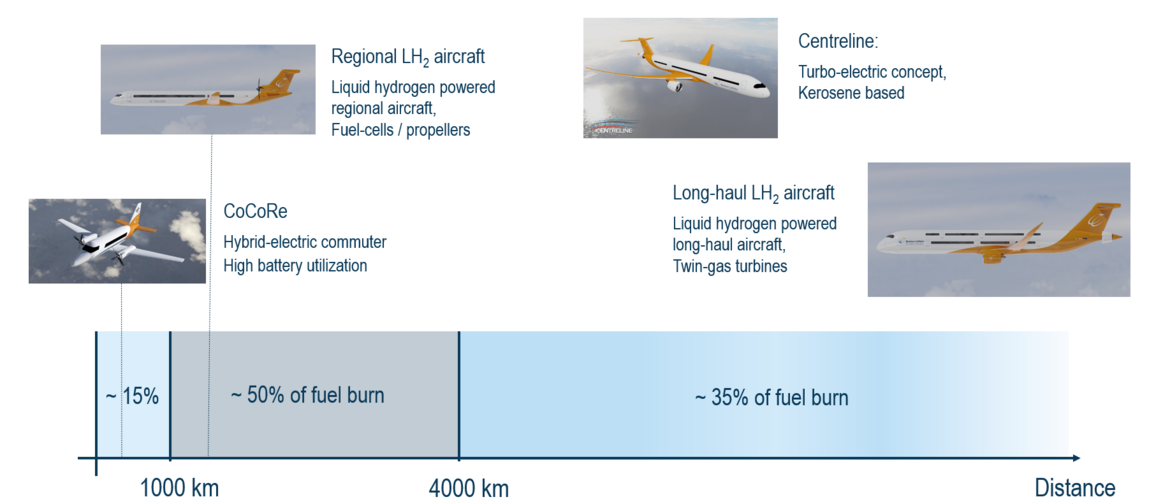
Beyond emissions savings through more efficient kerosene-powered aircraft, alternative energy carriers such as batteries or hydrogen offer significant potential for reducing the impact on the climate. Battery-electric powertrains have significantly higher conversion efficiencies than internal combustion engines. This particularly applies to low performance classes that are typically used in general aviation or regional air traffic. Electric motors suitable for air travel and the associated power electronics are at an advanced stage of development, with a power-to-weight ratio that makes them eligible for widespread use in aviation. In principle, batteries also offer sufficient power capacity, however, the energy density limits the retrieval of the required power to relatively short time intervals. That is why battery-electric flying will still be restricted to short flight distances for the foreseeable future. As outlined in Figure 1, the majority of the current fuel consumption occurs on routes that will also require energy-dense fuel in the future.
There are currently exciting developments in aviation research with regard to the direct use of green hydrogen as an energy carrier. In the future, hydrogen could be utilised in adapted gas turbines or via fuel cells in electric powertrain architectures. Niche applications for compressed hydrogen are conceivable on short flight routes as an extension of battery-electric flight; however, on most flight routes, liquefied hydrogen is necessary to demonstrate the potential benefits in the overall system. In terms of weight (without tank), liquefied hydrogen has around three times the energy content of kerosene, but takes up four times the volume. A redesign of the aircraft is necessary owing to the significantly different fuel properties. Liquefied hydrogen boils at - 253 °C, which is why insulated pressure tanks must be integrated to limit the evaporation rate and withstand pressure rises. These bulky, mostly cylindrical tanks are usually integrated into the fuselage, whereas kerosene is predominantly stored in the wings.
The majority of studies forecast a somewhat higher energy requirement per passenger kilometre for hydrogen aircraft than for kerosene-based comparative designs. On the basis of renewable hydrogen, there could still be advantages for hydrogen-based aviation when considering the overall system, as the energy required for liquefaction is far lower than the corresponding energy losses in the synthesis of PTL kerosene. The costs for the storage and logistics of liquefied hydrogen are higher than for kerosene, but remain within reasonable limits for the supply of large airports. The main challenges for infrastructure and logistics are seen in the early introduction phase and the supply of remote regional airports with few flight movements per day.
In addition to technological improvements, optimisations or innovations in the air transport system may also lead to fuel savings. Examples of optimised operational measures can be found in the area of air traffic management. For instance, existing fragmentation of the airspace can be reduced, approach trajectories optimised and movements on the ground carried out with just one turbine or tugs. Specific emissions per passenger kilometre can also be reduced through improved fleet utilisation. At the limits of technical improvements, the number of seats in the cabin can be increased. A further lever is a higher utilisation of the seats on offer, which is already around 80 % on a global average. More radical proposals aim to reduce feeder flights by sharing the seating capacity across airlines so as to enable a higher proportion of direct flights.
Civil aviation now almost exclusively uses gas turbines, which are characterised by a high power-to-weight ratio and high reliability. While gas turbines in stationary applications are usually operated with natural gas and are suitable for hydrogen in the future, liquid hydrocarbons are used as turbine fuel in aviation
due to the energy density required. The currently applicable specifications for aviation fuels have developed historically; for cost and availability reasons, it was desirable to have the broadest possible petroleum fraction, which was limited to short- and long-chain hydrocarbons for safety reasons. In particular, flash point and freeze point requirements ensure that commercial aircraft can be safely operated at cruising altitude both at elevated temperatures and at low outside temperatures.
Safe operation also plays a central role in the specifications of renewable turbine fuels — currently, an admixture of up to 50 % synthetic kerosene is permitted. New specifications that enable the safe use of fully synthetic fuels are currently being developed. Synthetic fuels offer benefits compared to conventional
jet fuel, such a higher degree of purity and a lower content of aromatic hydrocarbons, resulting in slightly higher efficiency and a significant reduction in pollutant emissions, which also leads to a lower non-CO2 climate impact. Still, the use of aromatic-free fuels requires technical adjustments, so these fuels are not yet compatible with the current fleet. According to the manufacturer, the latest generation of commercial aircraft is already designed for use with fully synthetic fuels.
Large volumes of liquid fuels need to be made available in order to fulfil the climate targets. The ReFuelEU Aviation Regulation requires fuel suppliers to gradually increase the proportion of sustainable aviation fuels at European commercial airports. As of 2025, a share of 2 % of renewable aviation fuel must be blended in, with the minimum quota rising to 70 % by 2050. Biofuels are only eligible if they are produced from advanced feedstocks; exclusion criteria apply to food and animal feed in particular, and a sub-quota is intended to support the market launch of PTL fuels.
It seems reasonable to suppose that early blending quotas will mainly met by HEFA fuels and by co-processing lipid-containing feedstocks in conventional petroleum refineries – both processes are suitable for kerosene production from residual material such as used cooking oil or waste fats. Technologically speaking, the HEFA process is largely analogous to the production of renewable diesel via a HVO process (HVO: hydrotreated vegetable oil).
The alcohol-to-jet process is another commercially established biofuel technology that is likely to play a huge role especially in countries such as Brazil or the United States, which now already manufacture large volumes of ethanol. However, sugar cane, sugar beet or various types of grain are primarily used for the production of ethanol, which are not generally eligible under ReFuelEU Aviation.
In the course of 2024, the European Union expanded the list of eligible feedstocks for the production of sustainable aviation fuels to also include damaged crops, crops cultivated on severely degraded land or catch crops such as second crops or cover crops. The extent to which these cultivation biomasses will contribute to compliance with quotas in air transport cannot yet be foreseen with sufficient certainty.
In the future, the increasing blending quotas will incentivise the development of advanced biomass conversion processes that use widely available waste and residual materials. Especially the conversion of lignocellulosic feedstocks, such as via biomass gasification, could produce significantly larger quantities of sustainable biofuels.
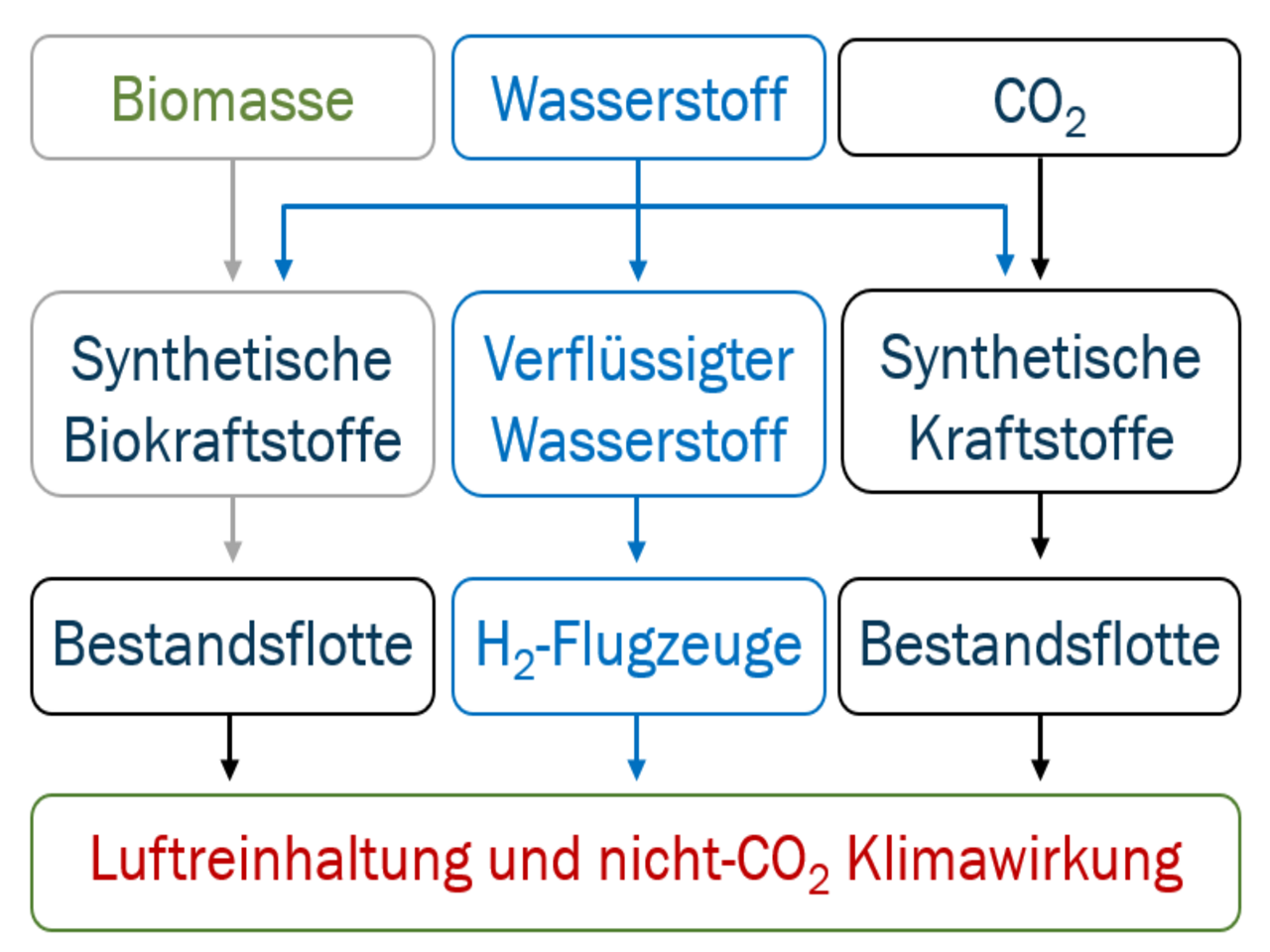
The significant cost reductions of renewable electricity production also bring the use of solar and wind energy within reach. In most cases, hydrogen is generated via electrolysis, which then serves to kerosene synthesis in combination with carbon dioxide. Typical synthesis routes lead via Fischer-Tropsch or methanol-to-jet processes. Such PTL fuels can potentially be produced in very large volumes and present clear benefits in terms of many sustainability parameters; the key challenge here is to reduce the production costs. In the medium term, the provision of large volumes of sustainable carbon dioxide, for example by capturing it from the ambient air, also poses a major challenge. Furthermore, green hydrogen can also be used for biofuel production, with many processes enabling a marked increase in the kerosene yield by coupling it with renewable hydrogen.
To date, the share of renewable aviation fuels has been less than 1 %, but it is rising rapidly. In this early ramp-up phase, the path towards climate-neutral aviation is associated with major uncertainties, especially as the established biofuel processes are limited by the availability of sustainable feedstocks. The future role of HEFA and ATJ fuels will depend on the extent to which these limited feedstocks are made available for use in the aviation sector with regulatory support. With a view to the cross-sectoral competition for use and sustainability considerations, it appears necessary to resort to comprehensively available feedstocks or forms of energy. That is why it is important to bring advanced biofuels and e-fuels to market maturity. When it comes to conversion technologies, such as biomass gasification, pyrolysis or hydrothermal liquefaction, there is still a significant need for research and development in order to establish these processes on the market. While it seems highly likely that the energy transition in air transport will be largely based on green hydrogen, various utilisation scenarios are conceivable
here, too. Whether green hydrogen will predominantly be used in combination with optimised biomass utilisation, for the generation of synthetic fuels from sustainable carbon dioxide or directly as an aviation fuel, remains to be seen.
The extent to which the various pathways come to bear in the future depends not least on technological developments, such as in the field of advanced biomass conversion processes, the capture of carbon dioxide from the ambient air or hydrogen-based transport aircraft. As all commercial aircraft available on the market are designed to use liquid hydrocarbons for the foreseeable future, large volumes of sustainable aviation fuels will be needed in any case to achieve the climate targets by the middle of the century.
Download the monitoring report “Renewable Energy in Transportation” from the Deutsche Biomasseforschungszentrum DBFZ.
View the full publication