
The transition to 100% renewable energy is a key element in every strategy toward climate-neutral aviation. The aim to realistically model the evolution of the energy mix, its cost, and climate impact, is an integral part of the overall goal to evaluate future strategies in four holistic cost-benefit-driven aviation scenarios. (scenarios)
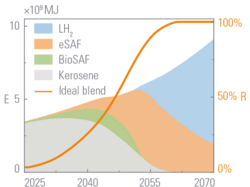
(R) in an ambitious hydrogen-led scenario
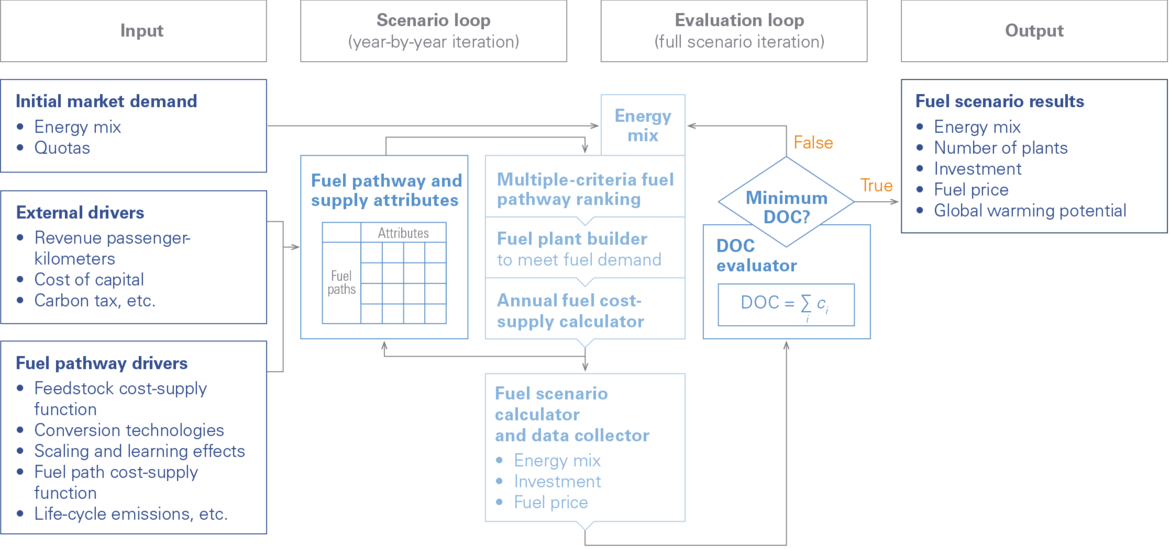
Bauhaus Luftfahrt developed a unique, fast, and flexible methodology to simulate the evolution of the future energy mix, based on a complex socio- and techno-economic model that aims to minimize the fleet’s direct operating cost (DOC). Under this constraint and production potentials, regulations, and market mechanisms, the fuel quantities, fuel cost-supply relations, and climate impact were obtained. Combining 8 conversion technologies1 with 42 feedstock types resulted in a total of 270 fuel production options distinguished by country. To implement quotas, the fuel production options were clustered into four categories: kerosene, bioSAF, eSAF, and LH2.
As a result, the future energy mix and its financial, environmental, and social cost impacts were obtained for different cornerstone scenarios. Common in all scenarios is the large global investment demand in renewable fuel production plants, which results in a fuel blend price that gradually increases to beyond 200% of the initial price. The scenario results differ in the trade-off of near- and long-term costs and benefits, with hydrogen aviation showing the largest potential for mitigating climate impact. The methodology provides a powerful approach for holistic decision-making in strategies toward climate-neutral aviation.
Methodology outline of the economic modeling
of the energy mix, investment and fuel-price evolution, including assumptions for external drivers such as demand for revenue-passenger-kilometers, carbon tax, mandates etc., and technology assumptions. The economic modeling simulates market mechanisms that minimize the direct operating cost.
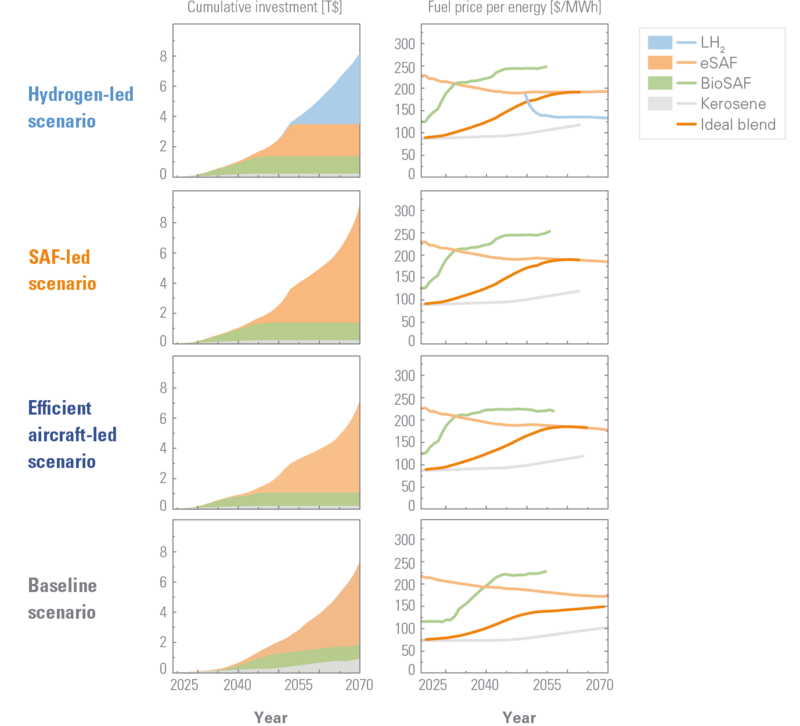
Investment cost and price evolution
Left: Investment cost (cumulative since 2025) in kerosene and renewable energy will rise to an order of magnitude of approx. $8 trillion, with an early ramp-up and limited fraction of bio-based SAF in all scenarios. Right: The evolution of the fuel price (ideal blend and hydrogen) and of its blend fractions.
SAF sustainable aviation fuel, BioSAF bio-based SAF, LH2 liquid hydrogen, eSAF electricity- based SAF
Glossary:
SAF sustainable aviation fuel,
BioSAF bio-based SAF,
eSAF electricity-based SAF,
HEFA hydro-processed esters and fatty acids,
AtJ1/2 alcohol-to-jet first/second generation,
BtL biomass-to-liquid,
PtL DAC direct air capture-based power-to-liquid,
PtL PS CO2 point source-based power-to-liquid,
LH2 liquid hydrogen,
DOC direct operating cost,
RPK revenue passenger-kilometers