
Short-haul services using electric aircraft could enable Regional Air Mobility (RAM) by providing point-to-point travel via regional airports, offering more efficient door-to-door journeys while reducing environmental impacts.
Using a passenger-response, agent-based demand model based on a 5% sample of the German population, we assessed the demand for 19-seat hybrid-electric aircraft in Germany and neighboring countries. Against car, rail, long-distance bus, and conventional aviation on a door-to-door basis, with the network including 235 airports or airfields, RAM delivers average time savings of ~48 minutes versus the fastest available mode on 25% of routes, and ~1.2 hours versus currently chosen modes on 35% of routes, with the strongest benefits on routes above 400 km.
Assuming up to ~80% CO2-eq reduction compared to conventional aircraft by 2050 and ticket prices comparable to first-class rail in Germany, early adoption is most likely among business and higher-income travelers, particularly for trips longer than 400 km and those originating from suburban and rural areas. RAM can also improve the overall ease of travel moderately, especially for high-income and business travelers and on longer-distance trips. These gains are similar for routes with urban and non-urban origins.
Overall, RAM has the potential to improve travel times and the overall ease of travel, motivating the need for technological solutions that can deliver credible performance and scalable operations at competitive cost, while meeting the safety, certification, and infrastructure requirements for real-world deployment.
Travel time savings by RAM
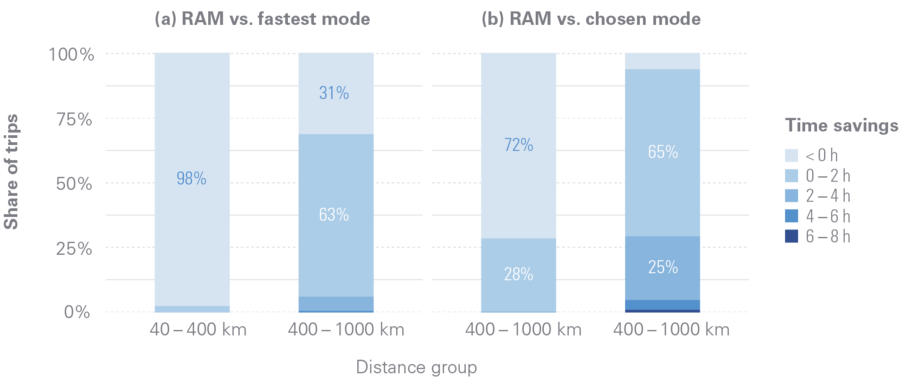
Against the fastest mode, RAM offers little to no time advantage on routes below 400 km. For longer trips, time savings increase, and the chosen-mode benchmark yields the more pronounced gains.
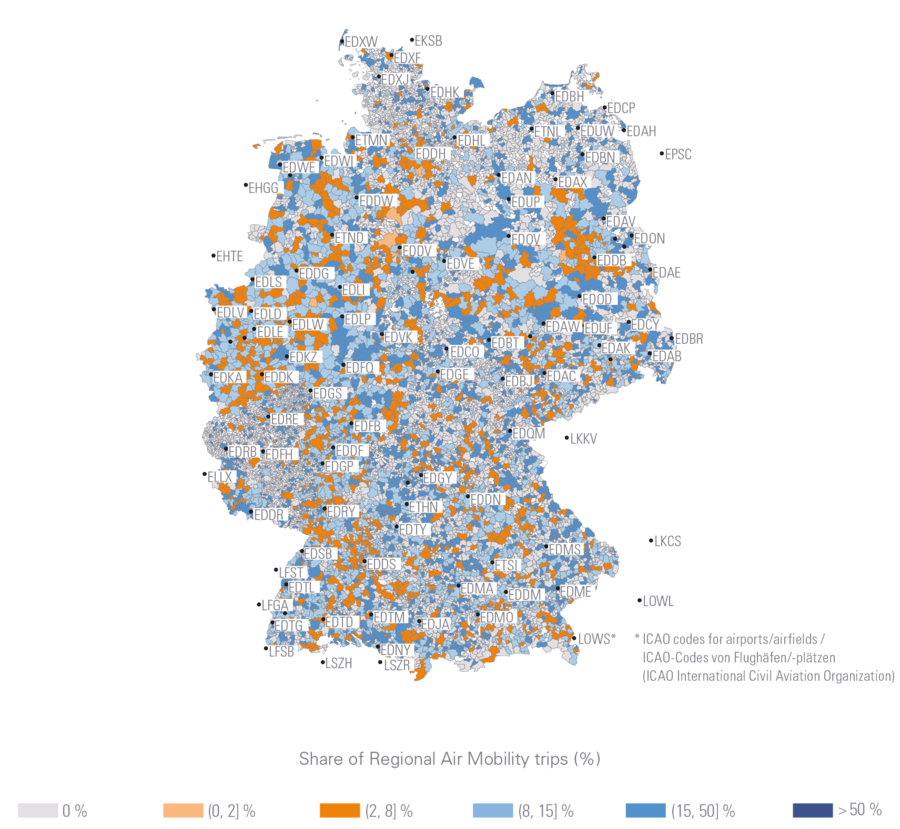
Spatial distribution of RAM trips across Germany (total share 10%)
For trips up to 950 km within Europe originating from Germany, RAM reaches its highest share in Bremen (14%), followed by Saarland (13%), and Mecklenburg-Vorpommern (12%), while Hamburg and Berlin record the lowest shares (8%).

The development of the research method is supported by the German Federal Ministry of Economic Affairs and Energy under the funding code 20M2252B.