
The H2Avia research project provided a comprehensive assessment of liquid hydrogen (LH2) as a primary energy carrier for civil aviation. By integrating the entire value chain, from sustainable production and airport infrastructure to multidisciplinary aircraft design and global fleet modeling, the project established a quantitative basis for evaluating LH2’s role in climate change reduction by 2050.
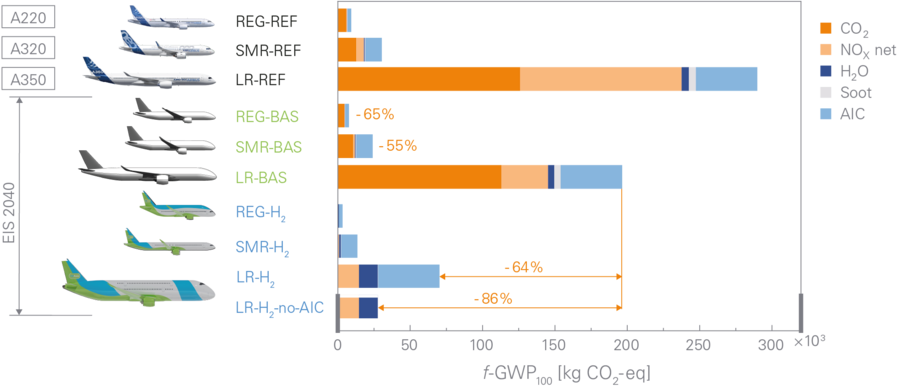
The study compared 2050 scenarios using legacy (reference) aircraft with an entry into service of 2040 powered by sustainable aviation fuel (baseline), and hydrogen-powered configurations with the same technology status. The focus is placed on the most relevant Aircraft sizes: regional, short-range, and long-range. Due to the penalties introduced by LH2’s cryogenic storage systems and low volumetric energy density, typical mission energy increased between 16 and 20% depending on aircraft size. However, the reduction of efficacy-weighted global warming potential (f-GWP) for the air-craft’s typical missions reached from 55 to 64%. If a significant reduction in contrails is assumed for hydrogen aircraft, this figure rises further, e.g. to 86% for long-haul aircraft.
The aircraft were integrated into a fleet model, in which they were selected and employed for different optimization targets. The different targets yield different result scenarios. One scenario’s target function for the fleet assignment included operating cost and f-GWP. Here, the results indicated that a transition to hydrogen could reduce f-GWP by 60% compared to the baseline aircraft fleet and 78% compared to the legacy aircraft fleet.
Aircraft synthesis strategy
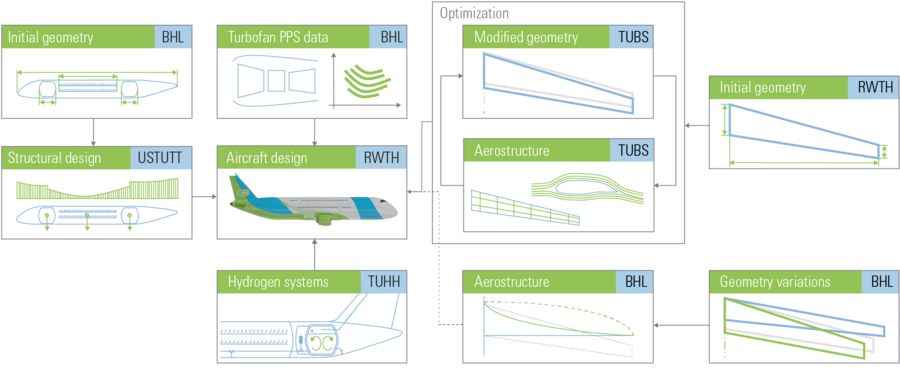
The aircraft designed covered all critical disciplines to capture the essential technologies for LH2 aircraft. All partner contributions were incorporated into the integrated aircraft design.
f-GWP comparison of typical mission
The f-GWP reduction is driven by the elimination of direct CO2 emissions and a substantial decrease in non-CO2 effects, such as NOx and soot-induced contrails.

The underlying project was funded by the German Federal Ministry of Economic Affairs and Energy under the funding code 20E2106A.