
The maturation of hydrogen-powered aircraft design faces several challenges before such climate-friendly aircraft can enter product development. Bauhaus Luftfahrt is currently investigating technologies to provide solutions to these challenges.
The fuel volume and necessary isolation to store the cryogenic LH2 require fuselage tanks. The DWiTE project explores the design space enabled by the resulting dry wings. By investigating alternative primary structure configurations and non-classical lift distributions beyond the elliptical optimum, the project provides first evidence of aircraft-level synergies between structure, aerodynamics, and systems integration.
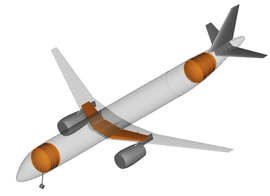
Further contributions by other partners include studies on manoeuver load alleviation via distributed control surfaces, hybrid laminar flow control, and the relocation of aircraft sub-systems into the wing. The CHoSe project in contrast addresses the integration of conformal CFRP (carbon fiber reinforced plastic) tanks for liquid hydrogen (LH2) in the wing, with the goal of reducing the performance penalty incurred by H2 tanks in the fuselage. The investigation shows no tangible performance benefit. However, this technology could be interesting for aircraft with thick wings and lower range, like people-movers. The project provides additional knowledge in the aerostructure sizing of the aircraft wing using mid-fidelity methods and the design of tanks for cryogenic fuels.
An LH2 fuel system will be different to kerosene and still contains many unknowns, especially around the masses. Therefore, the LH2 Overall-Aircraft-Design project marks a critical step toward more detailed liquid hydrogen fuel system modelling. Focusing on a fuel-cell-powered ATR72 and an H2-combusting A320 with aft-mounted tanks, it establishes a component-based fuel system architecture integrated into the BLADE design loop. The project results demonstrate that fuel line length and cold box mass dominate the overall system weight, correcting the severe underestimations of earlier lower-fidelity models.
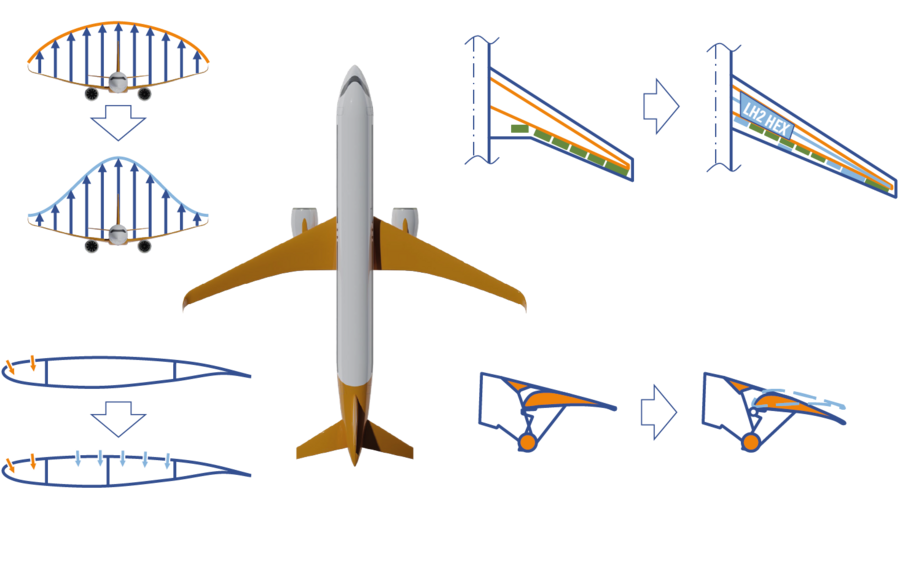
DWiTE technology components
A dry wing as investigated in the DWiTE project allows integration of technology components, alternative primary structure concepts, and lift distributions to enable laminarization, internal actuation, and enlarged control surfaces with active load control.
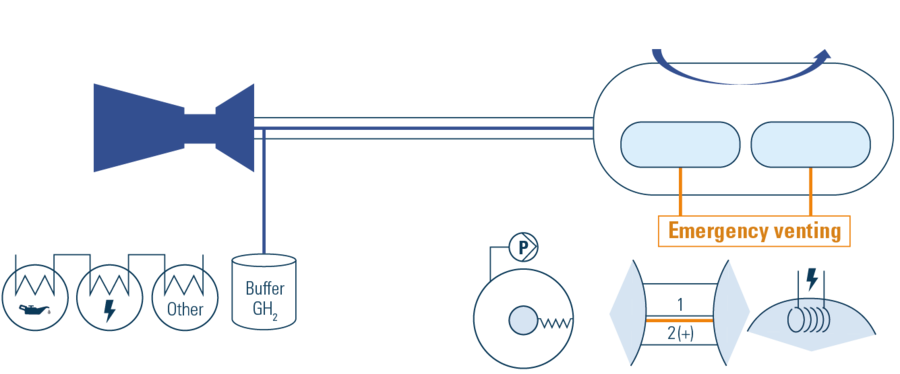
LH2 OAD fuel system model
For the detailed modeling and mass determination of LH2 fuel systems, the essential components for tanks, pipes, and H2 processing were defined in the LH2 OAD (overall aircraft design) project.
Glossary:
(L)H2 (liquid) hydrogen,
DWiTE Dry Wing Technology Exploration,
BLADE Bauhaus Luftfahrt Aircraft Design Environment,
CHoSe Conformable Hydrogen Storage for Aviation,
CFRP/CFK carbon-fiber reinforced polymer,
OAD overall aircraft design

The underlying projects were funded by the German Federal Ministry of Economic Affairs and Energy under the funding codes 20E2208A (DWiTE) and 20E2204B (CHoSe).