
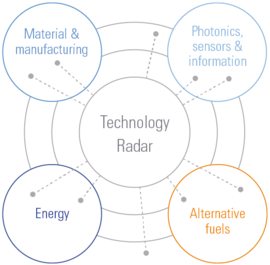
The established Bauhaus Luftfahrt Technology Radar approach is being transferred to the national level within the LuFo project ATLAS to identify technological advances with high long-term leverage for climate-neutral aviation, supporting the transition to renewable energy and improved efficiency. As a core element, Bauhaus Luftfahrt leads its implementation in a large consortium, contributing insights from its Technology Radar to jointly assess step-change technological advances in the aviation context.
Scaling power generation and conversion
On the radar are key signals addressing a central bottleneck of electrochemical propulsion: scaling power generation and conversion to the multi-megawatt levels required for larger air-craft – a prerequisite for realizing their full climate leverage. Two-phase cooling for polymer electrolyte fuel cells fundamentally enhances thermal management by reducing cooling-system mass and drag, thereby increasing system-specific power. At higher power levels, ultra-wide-bandgap semiconductors enable multi-kV power electronics with lower losses and reduced system mass, supporting efficient power transmission and further scaling. Progress in cryogenically cooled electric motors and superconducting power system components represent radar signals with high relevance for enabling step changes in power density and propulsion beyond 10 MW.
Solid oxide fuel cells for hybrid propulsion systems
High-temperature electrochemical technologies are also on the radar, in particular advanced solid oxide fuel cell (SOFC) technologies that enable highly efficient SOFC-gas turbine hybrid propulsion systems with significant climate benefits, as discussed in the following article.
Liquid hydrogen tank and storage systems
Advances in fiber-composite materials and efficient cryogenic insulation systems enable ultra-lightweight and multi-layer liquid hydrogen (LH2) tank concepts, reducing boil-off and refueling losses and thereby enhancing system efficiency and operational performance. Composite ducting flexibility further reduces installation volume, while integrated sensing supports safe and reliable LH2 storage and distribution.
Scalable supply of LH2
Additional radar signals address the scalable supply of LH2 and drop-in synthetic fuels, including coupling intermittent renewable electricity from wind and solar power with hydrogen production. Long-duration energy storage and dual hydrogen-electric storage and conversion systems balance renewable power fluctuations, enabling continuous hydrogen production and liquefaction despite intermittency in renewable energy supply. Within the power-to-liquid pathway, advances in direct air capture and emerging electrochemical CO2 conversion technologies support efficient synthetic fuel production.
AI as a key accelerator
Artificial intelligence (AI) is on the radar as a key accelerator for developing and integrating complex aviation technologies. Physics-informed AI, particularly transformer architectures, enables efficient modeling of tightly coupled multi-physics processes, supporting, among other things, the scalable design and optimization of high-performance two-phase cooling systems and, more broadly, enabling faster transition of disruptive technologies into practical application for climate-neutral aviation.
Consortium-wide implementation of the Bauhaus Luftfahrt Technology Radar approach

Phase 1: Technology scouting / Initial assessment & prioritization; Phase 2: Potential & risk analysis; Phase 3: Evaluation, application and recommendations
Multi-step process from broad scouting to stepwise assessment, prioritization and progressively refined analysis, applying proven methods to derive future-proof insights on long-term innovation potential for climate-neutral aviation and to guide informed decisions. Learn more about the ATLAS project
Key technologies on the radar

Innovation potential arises at the intersection of technology push from research advances and technology pull from the need to meet aviation’s climate targets and leverage digitalization.