Aviation’s net-zero targets require both sustainable fuels and highly efficient, low-emission propulsion systems. The EU-funded HYLENA project investigates a hydrogen-fueled innovative propulsion concept integrating an optimized solid oxide fuel cell (SOFC) into a gas turbine (GT) to recover energy from the SOFC exhaust stream.
The combined use of electrical and thermal power has the potential to achieve high overall efficiency (up to ηth ≈ 70%) with low NOX and zero CO2 in-flight emissions. Nevertheless, deploying SOFCs in aviation will require a step change in gravimetric power density, from the state of the art for planar designs of approximately 0.1 – 0.5 kW / kg to HYLENA’s targets of around 3.0 kW / kg. Therefore, this requirement frames one of the core objectives of the technology scouting activities.
Bauhaus Luftfahrt has identified and evaluated technological pathways toward SOFC stack concepts able to deliver high gravimetric and volumetric power densities while meeting aviation-relevant robustness criteria under dynamic conditions. [1]
Figures 1 and 2 summarize the current structure of the SOFC support concepts, highlighting how electrolyte-, anode-, and metal-supported structures evolve under different trade-offs. Electrolyte- and anode-supported cells remain the most mature and widely deployed, whereas metal-supported cells are emerging as particularly attractive candidates for aviation applications.
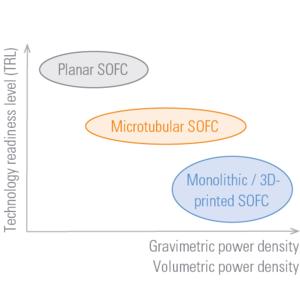
In parallel, alternative structural configurations are gaining attention. Specifically, microtubular and monolithic SOFC design offer significant potential for weight reduction and compact integration, as they eliminate the need for heavy interconnect plates of conventional planar designs. Together, these developments highlight the growing relevance of advanced SOFC architectures as enablers for high-efficiency SOFC-GT concepts in future aircraft propulsion systems.
Overview of SOFC support layers
Timeline showing the initial development of SOFC support technologies, with indicative thicknesses and operating temperatures of current generations.

Multi-criteria assessment of SOFC support technologies
Qualitative cell-level assessment of SOFC support concepts, comparing relative performance across key metrics and typical operating temperature ranges. As shown in Figure 1, operating at larger temperature ranges is possible but involves trade-offs in performance, durability, or system complexity. Ongoing advances in metal-supported SOFCs show strong potential for dynamic aviation environments (e.g. high mechanical robustness), although further progress in degradation mitigation is needed. The spider plot reflects metrics of qualitative trends identified through extensive literature screening.

[1] M. Fikry, L. Koops, C. N. Dagli, C. Warsch and P. E. Roux, Status, Challenges and Perspectives of Solid Oxide Fuel Cells in Aviation, ECS SOFC XIX, 2025