
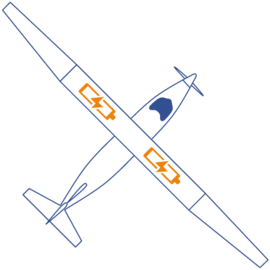
The BERTL research project addressed sustainable regional air transport by developing a battery-electric aircraft. A key aspect of the vehicle was the high aspect ratio wing with integrated batteries.
Both features minimize required energy and thus battery mass. The conceptual aircraft design by Bauhaus Luftfahrt was executed with the multidisciplinary design environment BLADE. The specific task was to explore the performance of an aircraft family based on the BERTL baseline aircraft.
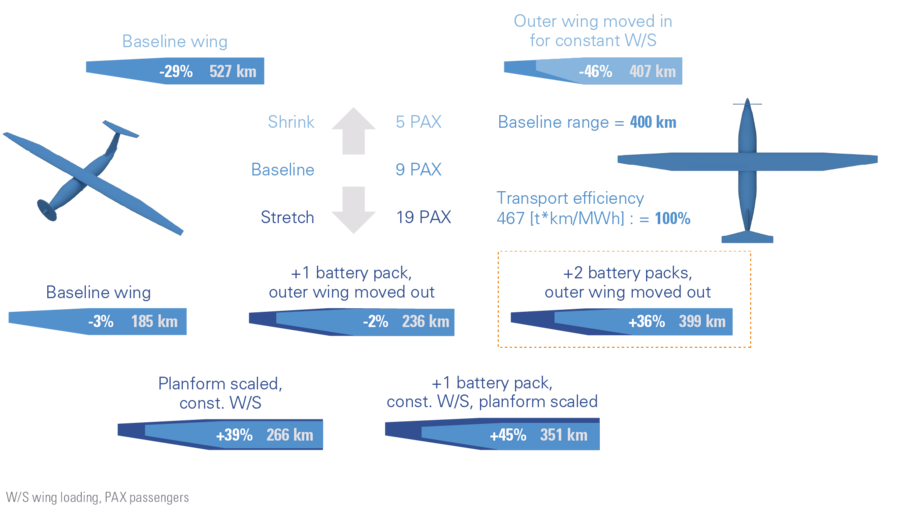
Centered around the 9-passenger baseline model, calibrated against the Vaeridion aircraft, an aircraft family ranging from 5-passenger “shrink” to 19-passenger “stretch” was created. Different designs were executed featuring various wing sizing strategies to analyze trade-offs between component commonality, transport capability, and efficiency. For the 19-passenger stretch variant, extending the inner wing to accommodate two additional battery packs, totaling 3.6 t was found to be optimal. This configuration preserved the baseline range of 400 km while yielding a 36% increase in transport efficiency (payload * range / energy). The extension of the wing adds to the aircraft’s footprint changing span from 24 m to 30 m, aspect ratio from 16 to 20, and maximum take-off mass from 5.7 t to 9.2 t. The resulting span is a favorable compromise in terms of aerodynamics and mass.
In general, the airframe-efficiency of battery-electric aircraft is even more critical than for conventional aircraft, requiring high performance solutions. The results indicate that larger payloads are demanding in terms of battery mass and volume while also having a positive impact on transport efficiency. The scalability of battery-electric aircraft in terms of payload remains a relevant research topic.
Wing design strategies
The various wing designs yielded different transport efficiencies and ranges. The design with two added battery packs and an inner wing extension achieved the baseline design range and an efficiency increase.
Common and unique components
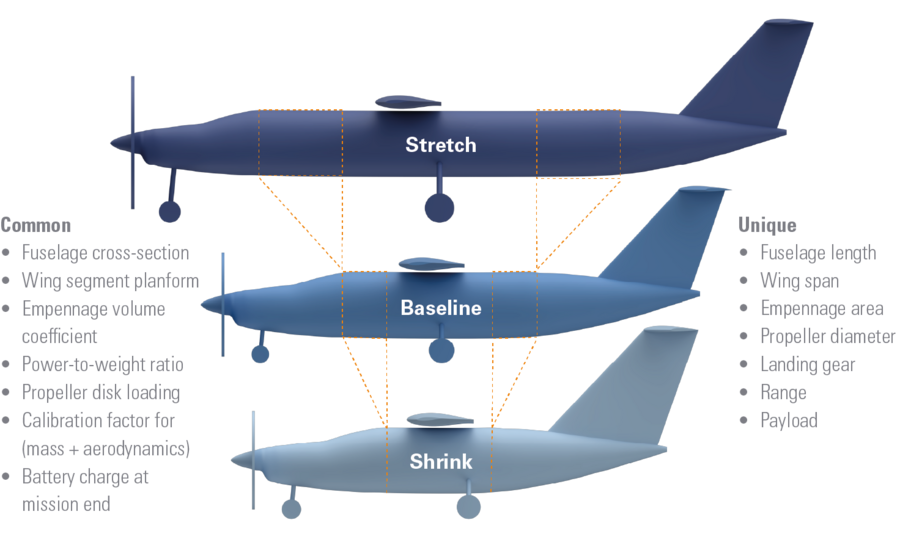
The fuselage adaptation followed the conventional approach, keeping the cross-section and inserting/eliminating frames. For other components (e.g. empennage), unique items were chosen to increase the family members’ performance.

The development of the research method is supported by the German Federal Ministry of Economic Affairs and Energy under the funding code 20M2252B.