
Europe’s ambition for seamless, sustainable long-distance mobility requires air and rail systems to operate as an integrated whole rather than as isolated modes. The MultiModX project, funded under the SESAR 3 Joint Undertaking, addresses this challenge by developing and validating decision-support tools that enable coordinated planning, performance assessment, and disruption management across air and rail networks.
The Assessment Solution introduces the first digital catalogue of multimodal performance indicators in Europe, enabling passenger-centric evaluation of door-to-door travel time, reliability, cost, and environmental impact.
The Schedule Design Solution jointly optimizes air and rail timetables, demonstrating in a Spanish case study reductions in average connection buffer times and door-to-door travel durations, while increasing connecting passenger volumes by up to 7.5%. The Disruption Management Solution dynamically replans multimodal schedules under disturbances such as airport or rail link closures; simulations show reductions of nearly 20% in average journey times, 17% fewer stranded passengers, and up to 50% lower delays under centralized coordination.
All solutions are underpinned by a common analytical backbone of passenger archetypes, regional archetypes, and policy packages, allowing impacts to be assessed under diverse behavioral and regulatory contexts. By demonstrating how data-driven coordination between air and rail improves efficiency, resilience, and passenger experience, MultiModX provides a concrete pathway toward the four-hour door-to-door travel vision of Flightpath 2050.
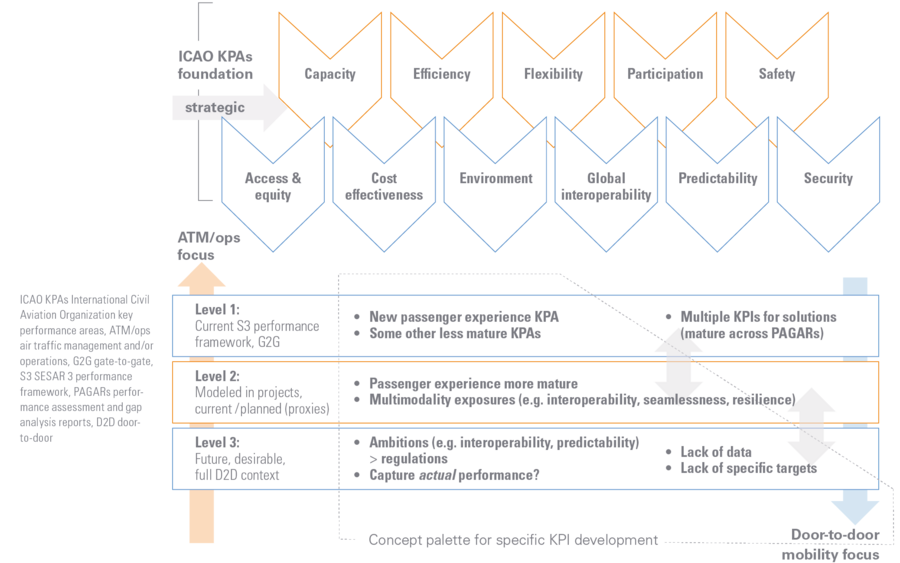
Multimodal performance assessment framework
Passenger-centric indicators evaluate time, cost, reliability, and emissions across modes.
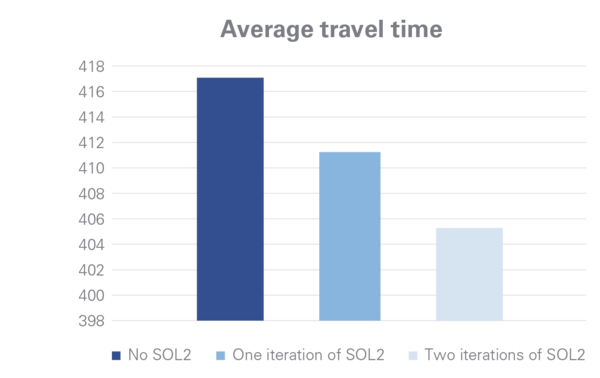
Significant travel time reduction
The Schedule Design Solution (SOL2) is capable of significantly reducing travel times in connecting itineraries by reducing buffer times, i.e. additional time spent between connections.

This project has received funding from the SESAR 3 Joint Undertaking under the European Union’s Horizon Europe program (Grant Agreement No. 101114815).