
Fleet sharing and the pooling of passenger flows across airline boundaries replace a purely airline-specific perspective with a system-wide one: Airlines continue to compete commercially, but jointly optimize fleets, networks, and flight schedules. As a result, aircraft, airports, and airspace can be used more efficiently on a global scale.
Within the European-North American network analyzed in the NetShAir project, both fuel consumption and the required fleet size are reduced by more than 10%, while more efficient network structures decrease the number of flight movements. In addition to the environmental benefits, passenger flows are distributed more evenly, thereby reducing peak loads at many major hub airports.
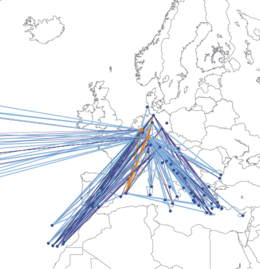
These efficiency gains result from structural changes in network design. Within continents, more passengers are enabled to reach their destinations via direct flights. In intercontinental traffic, by contrast, the share of indirect connections increases within the considered network. Fleet sharing makes aircraft utilization more flexible and enables more intensive use of highly efficient short- and medium-haul aircraft on transatlantic routes, provided that suitable intermediate stops close to the direct route are available.
The changes also reshape industry structures and regulation. Airline business models may evolve toward shared operations, aircraft manufacturers have to adapt to changing requirements, and adjustments in aviation and competition law need to enable implementation.
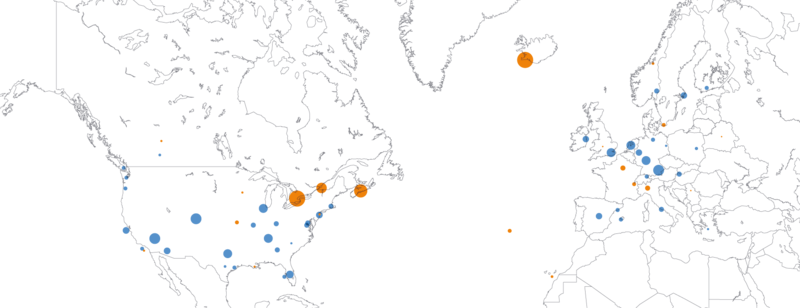
Changing traffic patterns
Evolution of passenger volumes at major airports after the introduction of the sharing concept in North America and Europe.
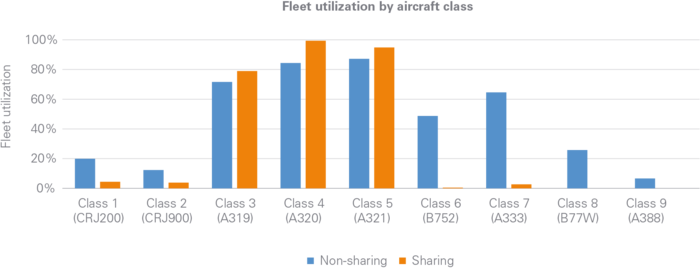
Changing aircraft usage
Utilization of the existing aircraft fleet in optimized European-North American flight networks with and without aircraft sharing.

The underlying project was funded by the German Federal Ministry for Economic Affairs and Energy under the funding code 20E2123A.