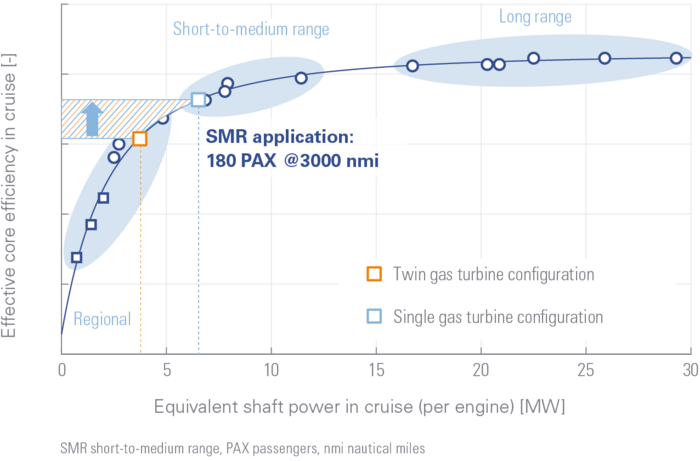
The gas turbine (GT) remains a crucial element for aircraft thrust and power generation due to its high specific power, reliability, and optimized design. However, as aircraft have become structurally lighter and aerodynamically even more efficient, less thrust is required for a given air transport task. This has led to ever-shrinking engine core sizes and corresponding penalties in GT thermal efficiency – a particular challenge for short-to-medium range (SMR) applications.
As a result, SMR aircraft could be powered by single gas turbine (SGT) propulsion systems instead of two GTs. The most favorable SGT propulsion systems synergistically combine the GT with an advanced fuel cell (FC). These so-called FC-SGT hybrids are fueled by hydrogen and leverage the unique strengths of both the GT and FC. As FC technologies have rapidly progressed in recent years, FCs could soon be utilized to power aircraft sub-systems and potentially generate a good portion of the aircraft thrust without emissions.
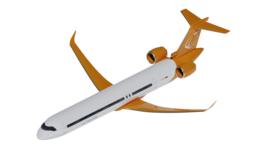
FC-SGT hybrid-powered short-to-medium range aircraft
Additionally, the FC product water can be harvested, evaporated, and injected into the GT to improve performance and significantly reduce NOx emissions.
FC-SGT hybrids offer a variety of different propulsion system designs and operation strategies by adapting the power split between the GT and the FC as well as the FC product water utilization strategy. Depending on the mission requirements, both parameters can be optimized to reduce emissions and fuel burn or to maximize thrust. However, all this needs to be achieved within strict certification requirements and accounting for all propulsion system failure cases.
Single gas turbine propulsion for the short-to-medium range:
Impact on gas turbine sizing power and effective core efficiency in cruise.
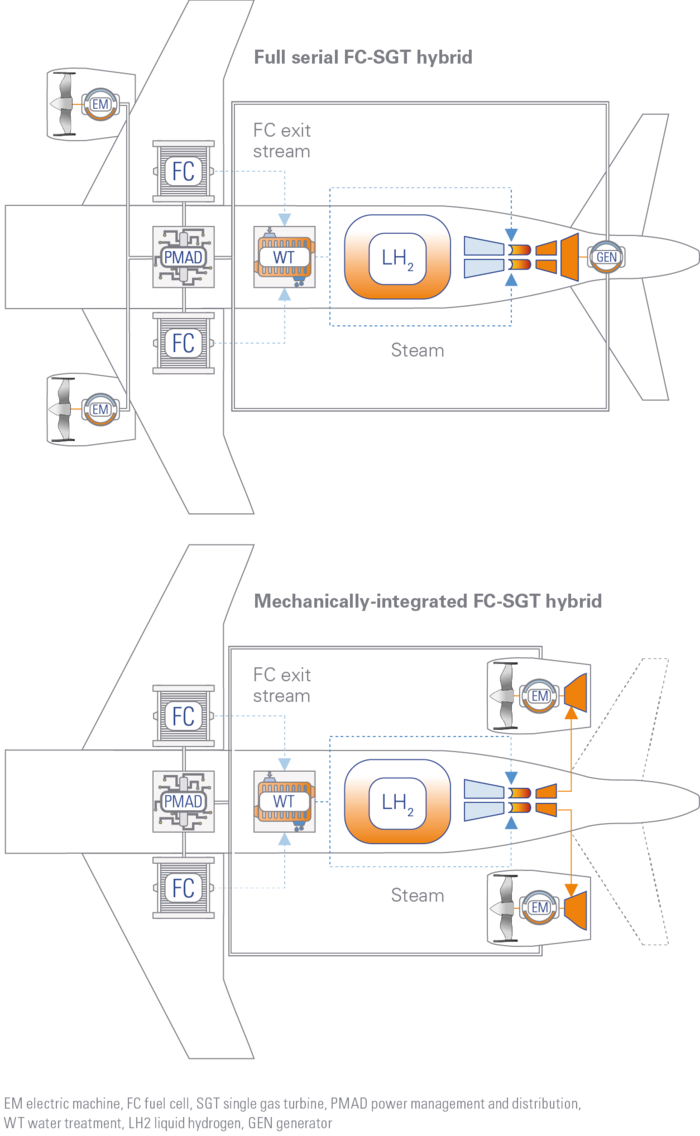
Aircraft integration options FC-SGT hybrids:
Both the full serial and mechanically-integrated architectures must be designed and integrated to minimize losses while accounting for propulsion system failure cases.