
Despite successful efforts to replace the conventional gas turbine for regional and short-range aircraft, for long-range (LR) applications, gas turbines will remain widely utilized due to their high power-to-weight ratio. However, disruptive configurations and synergistic combinations with other propulsion technologies show significant potential. One promising option, especially for LR applications, is the Composite Cycle Engine (CCE), where a piston system is combined with a conventional turbofan architecture.
Besides the usage of kerosene, liquid hydrogen may be employed for CCEs, with zero in-flight CO2 emissions. In particular, the free-double piston (FDP) CCE, which consists of a crankshaftless, free piston that acts as a gas generator and replaces the high-pressure compressor, has emerged as the most beneficial configuration.
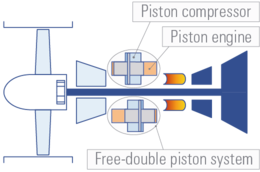
Engine architecture and components of the Composite Cycle Engine (CCE) with a free-double piston (FDP)
The closed-volume combustion process in the piston engine and high cycle temperatures and pressures offer significant fuel consumption improvements compared to turbofans, despite an increase in engine weight. To reduce NOx emissions, a system is installed that injects water into the piston system.
The core challenges related to CCEs, including operability over the whole flight envelope, NOx emissions, increased engine weight, vibrations, and mechanical complexity, are currently addressed in the EU-funded projects MINIMAL and EXAELIA. The efforts concentrate on providing first CCE designs and requirements for a scaled propulsion flying test bed.
TSFC and relative fuel burn in part power
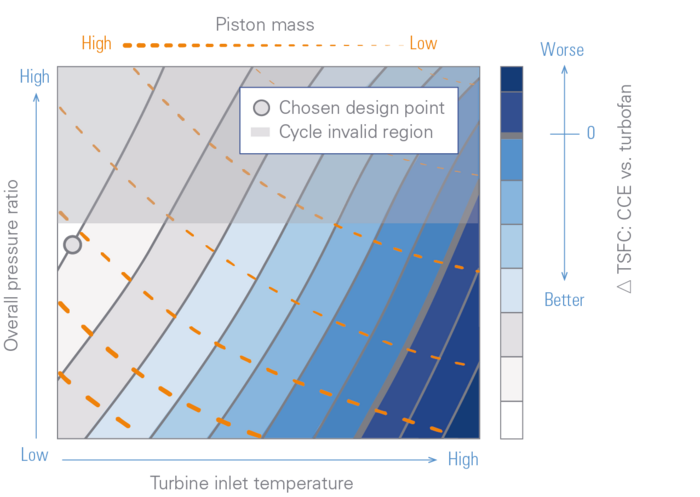
At the chosen cruise point, the thrust-specific fuel consumption (TSFC) improves by double digits for the CCE compared to a representative turbofan engine. 84% of the total fuel is burned in the free-double piston (FDP).


Performance of the CCE
TSFC and the piston mass decrease with increasing overall pressure ratio, whereas an increasing turbine inlet temperature increases TSFC. The invalid region is due to FDP outlet temperature limits.


MINIMAL: Funded by the European Union under the Horizon Europe Grant Agreement No. 101056863 and by the UK Research and Innovation (UKRI) funding guarantee under contract Nos. 10040930, 10053292 and 10039071. EXAELIA: Funded by the European Union under Grant Agreement No. 101191922.