
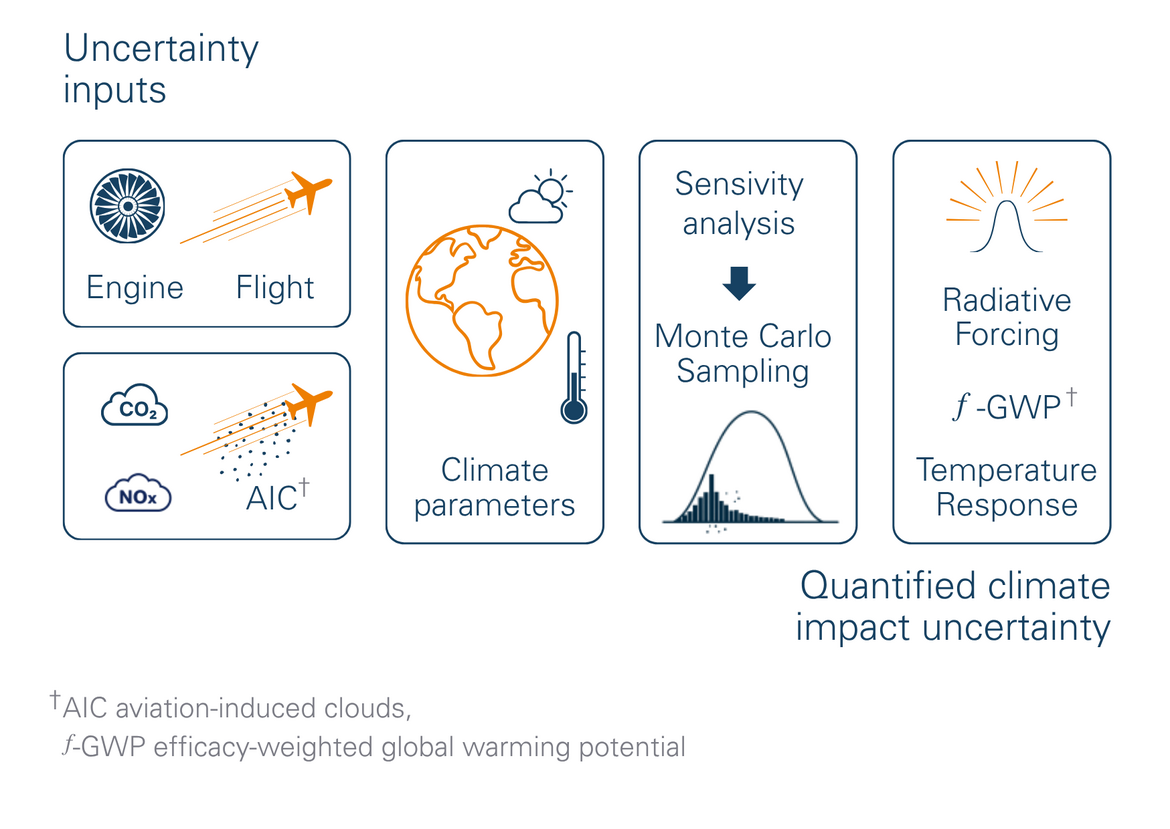
Climate impact is becoming a design criterion for future aircraft. But how uncertain are estimates of aviation's non-CO₂ effects, and what does this mean for aircraft design? A study by Bauhaus Luftfahrt and Technische Universität Dresden developed a process chain that connects flight mission and engine performance modeling with emission and simple climate-response models.
Carbon dioxide (CO2) emission is not the only way aviation affects the climate. Nitrogen oxides (NOₓ) and contrails also change the atmosphere and can contribute to global warming. These effects act over very different timescales. CO2 can remain in the climate system for centuries, while contrails typically last from a few hours to a few days. Yet, despite these different lifetimes, the non-CO2 effects can contribute substantially to the overall climate impact of a flight.
Why non-CO₂ effects matters for future aircraft
Non-CO2 effects become particularly relevant when climate impact is used to compare future aircraft or propulsion technology concepts. A deterministic calculation may suggest a clear advantage for a given technology, but that climate gain may become less clear once the uncertainties of the underlying emission and climate models are considered.
Future aircraft concepts can change several climate-relevant quantities at the same time: fuel burn, engine operating conditions, NOₓ emissions and particle emissions, as well as contrail effects. Comparing technologies using only a single deterministic climate value can therefore hide how confident we are in the predicted difference between concepts.
The aim of this type of analysis is to understand where that uncertainty comes from. This helps identify where better measurements and models are most needed and makes future technology assessments more transparent.
From a single estimate to a distribution of possible outcomes
Rather than reporting only a single climate-impact value, the new developed framework also quantifies how uncertain that value is, expressed as a distribution of possible values.
To do this, the calculation is repeated thousands of times while uncertain inputs are varied within plausible ranges. This approach, known as Monte Carlo simulation, shows how uncertainty propagates through the models; a sensitivity analysis then shows which inputs matter most.
For the case study, 21 uncertain parameters were considered, ranging from fuel consumption and emission indices to climate forcing factors. Some inputs, such as the amount of CO₂ produced per kilogram of fuel, are relatively well known based on the carbon content of conventional jet fuel; others show a much wider spread in the scientific literature. The result is therefore a distribution of possible outcomes rather than a single best estimate.
How do we handle contrail uncertainty?
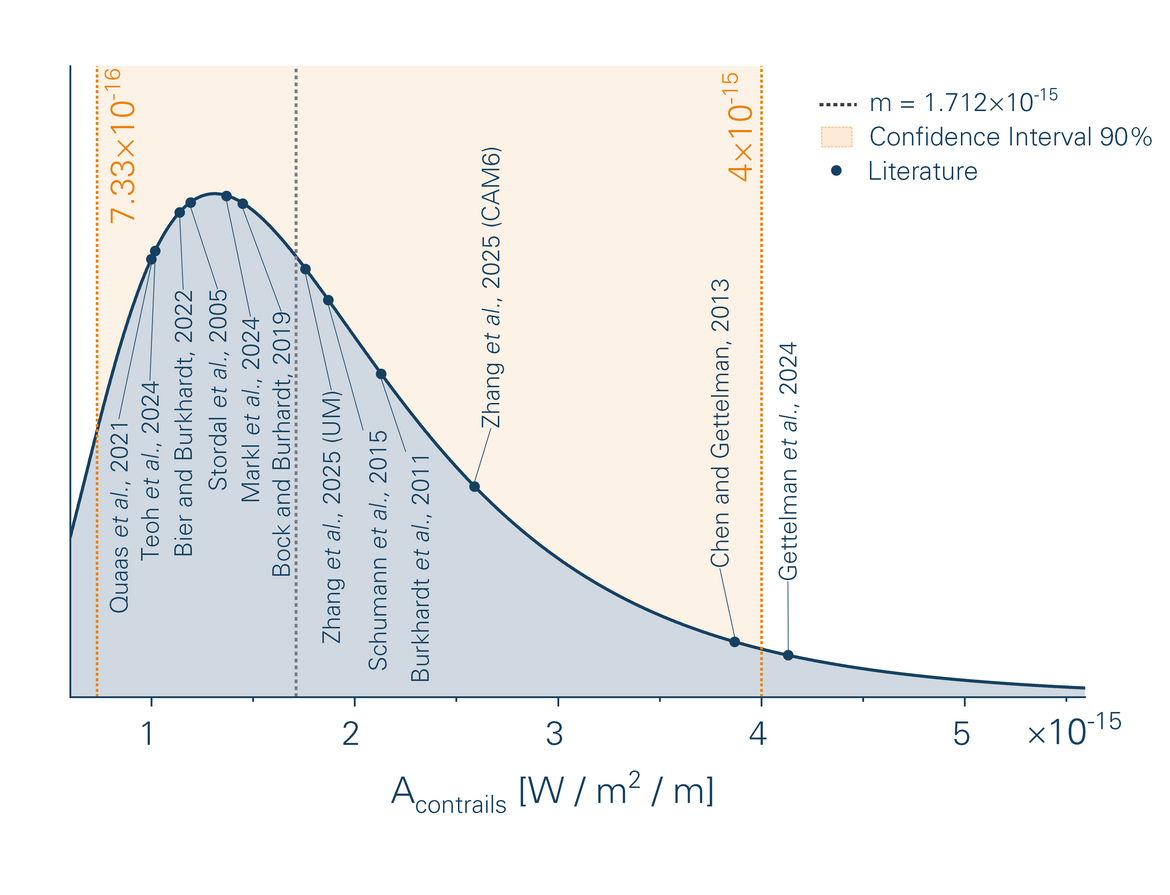
Contrails are a good example of an effect for which much of the uncertainty arises from limited scientific knowledge, often referred to as epistemic uncertainty. Unlike natural variability, this type of uncertainty can in principle be reduced through better measurements and improved models. To quantify it, we compiled published estimates of the annual-average climate forcing from contrails per kilometer flown across global aviation. Rather than selecting a single value, these estimates were used to construct a probability distribution. This distribution combines the spread in current scientific estimates of contrail climate forcing into a single uncertainty representation, which is then propagated through the Monte Carlo analysis.
What can a single example flight tell us?
The framework was demonstrated for an Airbus A320-200 flying about 1,400 km, representative of a flight from Germany to Spain. The case study is not intended as a global average. Instead, it shows how the method can resolve the climate impact of a specific aircraft, engine and mission, providing a basis for assessing future aircraft designs.
CO₂, NOₓ and contrails emerge as the main contributors to warming in this example. Their effects, however, evolve very differently over time. Contrails are short-lived, but their climate effect can be strong shortly after a flight and then fades. CO₂ has a smaller immediate effect, but its influence persists for centuries. When these effects are integrated over longer time horizons, their relative contributions also depend on the climate metric used. Our discussion focuses on efficacy-weighted Global Warming Potential over 100 years (f-GWP100), which weighs each effect by how effectively it warms the surface while remaining compatible with established regulatory metrics by keeping the conventional 100-year horizon.
The uncertainty is also unevenly distributed. For CO₂, the contribution to global warming is relatively well constrained. For NOₓ and contrails, uncertainties in both emissions and climate response are much larger, making them the main sources of uncertainty and the areas where improved models and additional measurements could most strengthen the climate-impact estimate.
Example flight Germany-Spain (1400km)
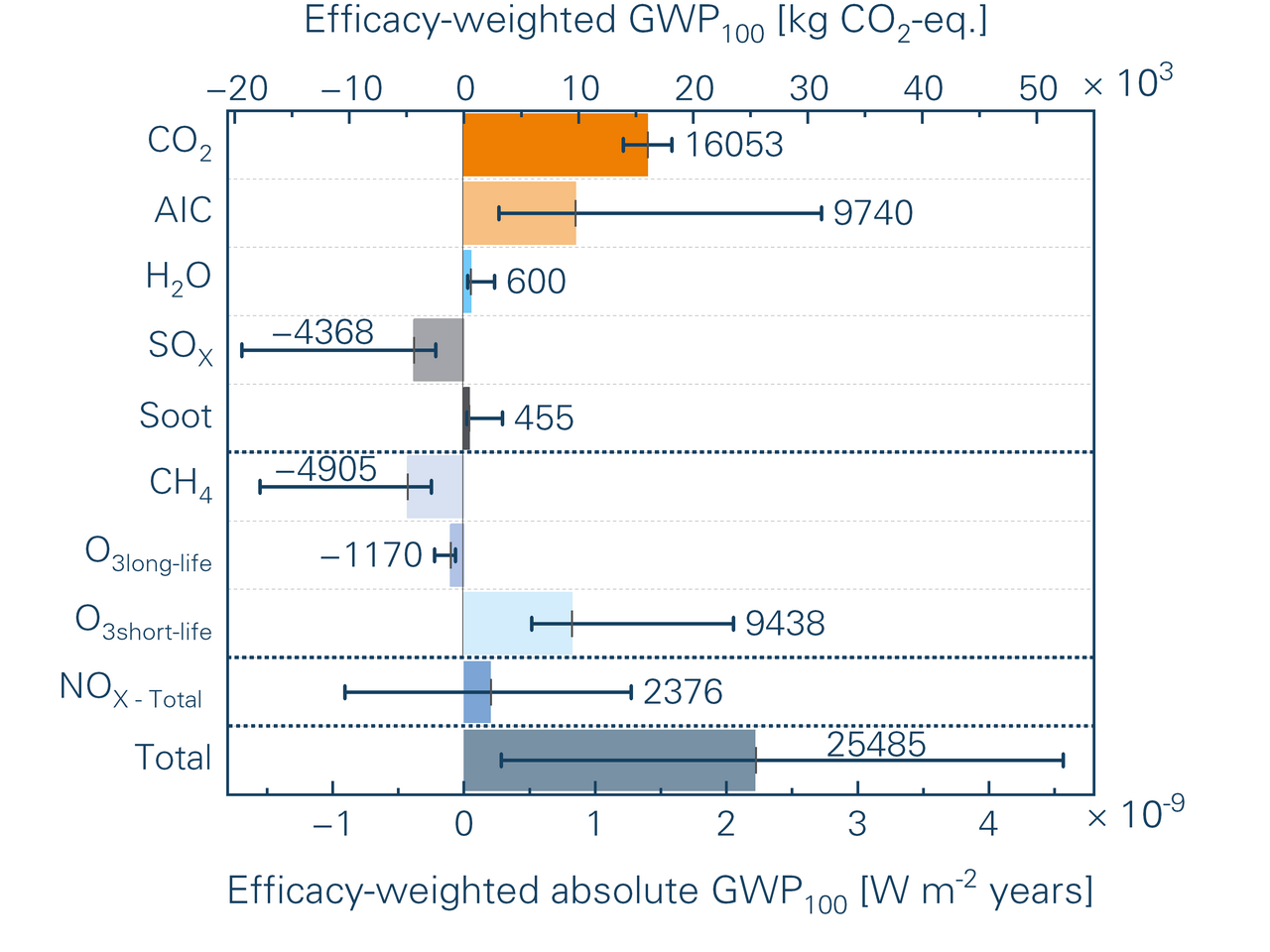
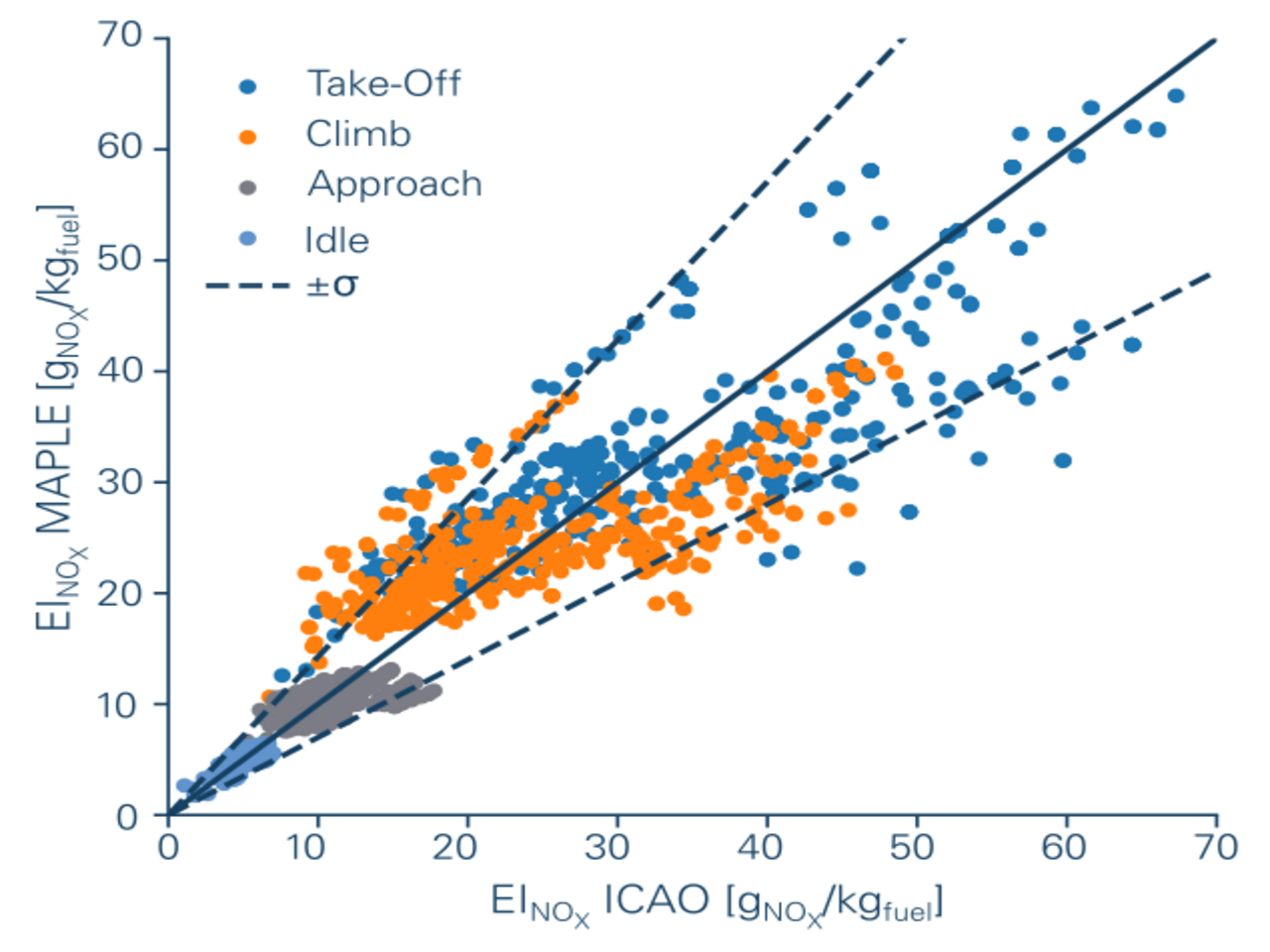
Combining uncertainties is not simple arithmetic, this becomes especially clear for NOₓ. Aircraft NOₓ emissions alter several atmospheric gases, including ozone and methane, producing both warming and cooling effects. Because these effects have broad and asymmetric uncertainty distributions, adding their individual median values does not necessarily give the median of their combined effect. In our case study, the individual medians add up to about 3,400 kg CO₂-eq, while the median of the combined distribution is about 2,400 kg CO₂-eq – a difference of more than 40%. This is why the full uncertainty distributions need to be combined, rather than simply adding an error bar to a deterministic result.

Looking ahead
Uncertainty will always be part of climate-impact assessment. Making it explicit and quantifying it helps turn an open problem into a clearer research agenda: where better measurements are needed, which models need improving, and which effects matter most for technology assessment. The next steps are especially important for reducing uncertainties around contrail and NOₓ effects, and for extending the framework from single flights to different aircraft, engines and fleet-level scenarios. This can provide a clearer view of future technology pathways and support more informed technology roadmaps.