
Environmental performance is a strong driver for the deployment of battery-electric RAM, which can surpass conventional short-haul aviation and potentially even high-speed rail.
To identify the main enablers – from aircraft design and operations to airport infrastructure – within the BERTL project, we combined a life cycle assessment (LCA) of a representative aircraft concept with insights from 16 interviews with mainly German regional airports conducted jointly with Vaeridion.
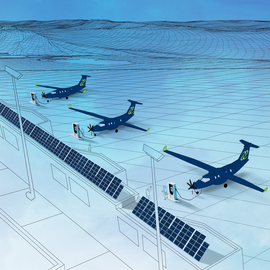
Both perspectives indicate that renewable energy availability at airports and their development into sustainable energy hubs is decisive for realizing the full eco-efficient potential of battery-electric RAM. The LCA shows that the use phase dominates life-cycle GHG emissions (cf. Fig. 1), making in-flight energy demand and carbon intensity of electricity for battery charging critical. It reveals a trade-off between faster travel and higher energy use, while demonstrating that operational levers – especially high load factors – together with aircraft efficiency improvements reduce emissions per passenger-kilometer (cf. Fig. 2). Airport charging with 100% renewable electricity offers the largest leverage, reducing per-passenger emissions by up to a factor of 7 and, as a key result, enables battery-electric RAM to compete with or even outperform high-speed rail environmentally.
The airport interviews support this finding, indicating willingness to accommodate electric aircraft and ambitions to evolve into sustainable energy hubs to enable new business models, while identifying grid/transformer capacity, on-site renewables and battery storage as key challenges and opportunities. Overall, renewable-powered charging and airport energy readiness emerge as key enablers for environmentally superior and scalable battery-electric RAM operations, alongside technical, regulatory, and infrastructure life-cycle considerations.
GHG emissions per life-cycle phase
Emissions are dominated by the use phase, followed by raw material extraction and refining. Renewable electricity (e.g. 100% photovoltaics) can reduce total GHG emissions by up to a factor of 7 under the projected German 2030 electricity mix (GEM), while recycled-material battery production can reduce the footprint by up to 17%.

Operational patterns strongly affect sustainability
Variation of greenhouse gas emissions with travel time, distance, and load factor for a representative battery-electric aircraft concept, illustrating trade-offs between travel time and environmental performance that can be partly balanced by higher load factors.


The project is funded by the Bavarian Ministry of Economic Affairs, Regional Development and Energy under the funding code HAM-2208-0029.